
I still remember the rainy, bone-chilling Tuesday evening a couple of winters back that almost made me swear off making homemade hamburger steaks forever.
I had been daydreaming all day about a rich, pub-style dinner: juicy, savory beef patties resting in a velvety French onion cream sauce, smothered under a blanket of molten Swiss cheese and topped with a shower of smoky, crisp bacon crumbles. It felt like the kind of dinner that could fix whatever a rough workday broke.
I thought I could just throw it together without overthinking it. I grabbed two pounds of lean ground beef, shaped four giant hockey pucks straight out of the package with no binders, seared them in a smoking-hot skillet, and poured heavy cream and canned French onion soup right into the raging grease. I slapped thick slices of cold Swiss cheese over the tops, slammed a lid on the pan, and walked away for ten minutes.
When I lifted the lid, my heart sank.
The heavy cream had boiled violently against the scorching cast iron and split into a watery, grey sludge with an oily film of separated beef fat floating on top. The meat patties had contracted into hard, rounded baseballs that felt like shoe leather under a fork.
Even worse, because I had dumped raw, cold bacon into the pan along the way, the bacon hadn’t crisped up at all; it was limp, pale, and rubbery, sliding right off the cheese like wet tape. When my partner cut into a patty, the meat was dry and chalky, completely devoid of juice. We ended up eating buttered noodles with a side of toast, and I spent twenty minutes scrubbing scorched cream off my favorite skillet.
That humiliating dinner bothered me for weeks. A skillet hamburger steak smothered in caramelized onion pan gravy and melted cheese is the undisputed pinnacle of vintage homestyle cooking.
Ground beef has practically zero connective tissue to break down into gelatin. If you don’t build in internal moisture cushions, mind your fat ratios, and respect dairy temperature thresholds, you are guaranteed to end up with tough, dry meat and broken sauce.
After half a dozen test batches, experimenting with panades, and nailing the two-stage bacon crumble technique, I finally cracked the code.
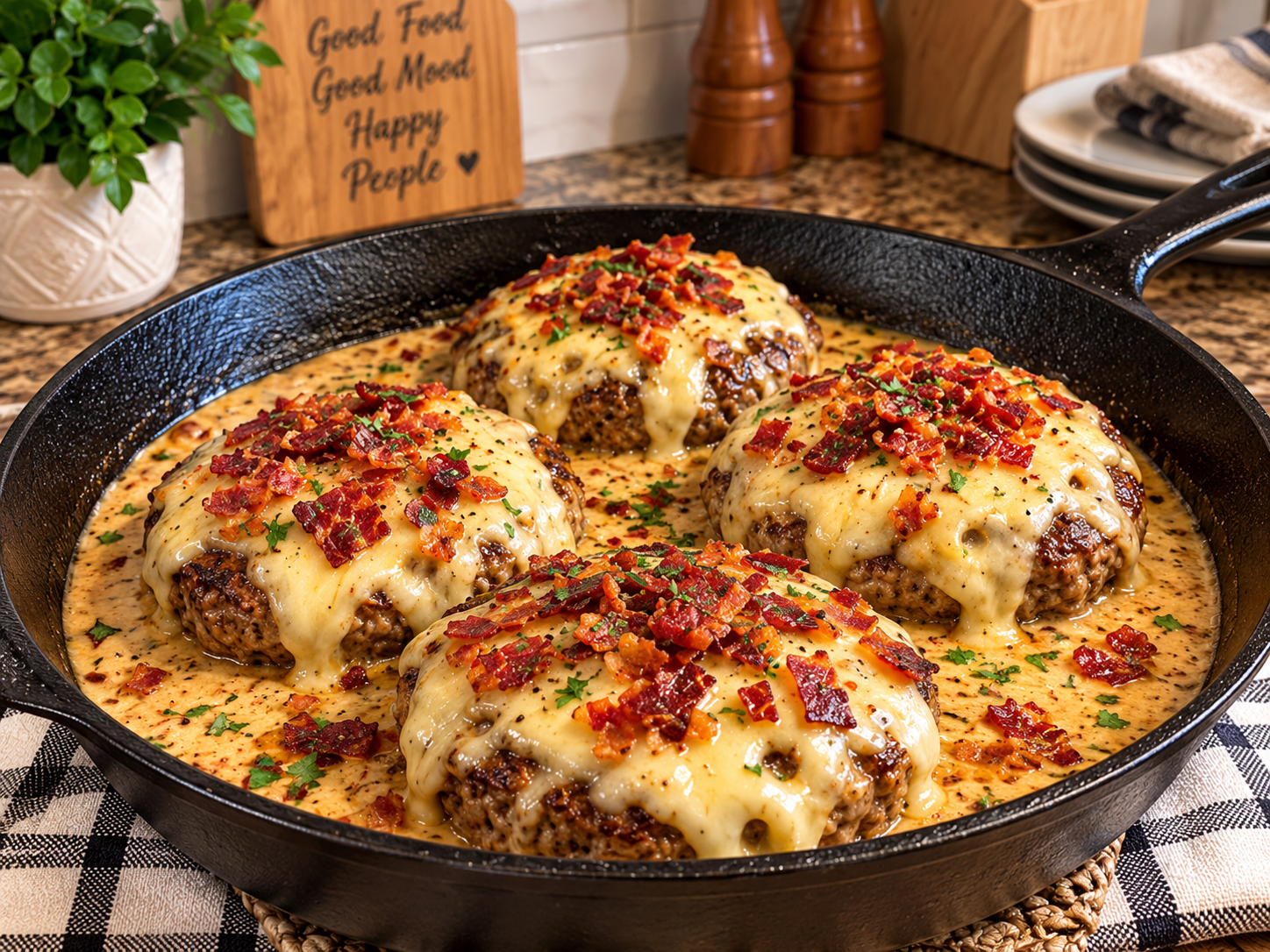
The photo above is the hard-earned victory sitting on my kitchen counter: four succulent, fork-tender beef patties nestled in a silky, thyme-scented French onion pan gravy, blanketed in a gooey, molten mantle of melted Swiss and Gruyère, and crowned with shatteringly crisp applewood bacon bits.
Here is how you make these restaurant-level French Onion Salisbury Steaks at home without drying out your patties or breaking your sauce.
Why Skillet Hamburger Steaks Turn into Dry Hockey Pucks (The Food Science)
Ground beef behaves very differently than a whole cut of steak. When you grind meat, you rupture the cellular membranes, leaving the muscle proteins exposed. If you make these three common mistakes, your dinner will suffer:
1. The Missing Panade (The Moisture Cushion)
Lean ground beef (or even an 80/20 blend) shrinks violently when exposed to direct skillet heat. The muscle proteins twist like wrung-out towels, expelling every drop of internal water. The only way to stop this is a panade: a mixture of plain panko breadcrumbs soaked in milk or beef bone broth until it forms a soft paste. When mixed into the beef, the starch grains trap the expanding juices and fats, keeping the interior tender, succulent, and crumbly rather than rubbery.
2. Overworking the Meat Matrix
Treating ground beef like bread dough is a death sentence for tender patties. The more you knead, compress, and squeeze the beef with your warm palms, the more you develop myosin—a structural protein that binds meat tightly together. This is great for bouncy sausage, but disastrous for Salisbury steak. Mixing with an open hand and shaping gently with damp fingers keeps the texture light and delicate.
3. Raging Boils and Dairy Emulsions
Heavy cream and melted cheese cannot survive a violent, roaring boil. If you pour dairy into a screaming-hot pan or let it boil hard, the emulsion breaks. The water separates from the milk fat, creating an oily, curdled disaster. The secret is caramelizing the onions, reducing the beef broth and wine down into a concentrated jus first, and then gently whisking in the cream over medium-low heat so it thickens into an unbreakable, velvet glaze.
Ingredients & Tools You’ll Need
Essential Kitchen Gear
- 12-Inch Heavy Cast-Iron Skillet: (A well-seasoned cast-iron skillet, like the black pan in the photo, provides unmatched heat retention, building a savory caramelized crust on the patties while holding the rich gravy at an even simmer).
- Digital Instant-Read Meat Thermometer: (A ThermoWorks ThermoPop or similar digital probe ensures you pull the patties at 155°F to 160°F before they turn dry).
- Flat Wooden Spatula: Mandatory for scraping up the rich beef and onion fond from the bottom of the cast iron.
- Wide Metal Spatula: For flipping the tender, delicate patties without breaking them in half.
The Ingredient Breakdown
| Component | Ingredient | Quantity | Practical Role |
| The Meat Base | 80/20 Ground Chuck | 2 lbs (900g) | Ideal fat ratio; delivers rich steakhouse flavor and stays moist. |
| The Panade | Plain Panko Breadcrumbs | ¾ cup | Light, airy crumbs that cushion the beef proteins against tightening. |
| The Panade | Whole Milk or Beef Bone Broth | ½ cup | Hydrates the crumbs to create a tender, melt-in-your-mouth bite. |
| The Binders | Large Egg | 1 whole (lightly beaten) | Helps the rounded oval patties hold their shape in the skillet. |
| Aromatic Base | Sweet Vidalia or Yellow Onions | 2 large (halved and thinly sliced) | Caramelizes into sweet, jammy ribbons for the French onion gravy. |
| Aromatic Punch | Fresh Garlic | 4 cloves (minced) | Delivers robust, savory depth to the onion sauce. |
| Savory Boosters | Worcestershire Sauce | 2 tbsp (divided) | Rich fermented umami backbone in both the patties and the gravy. |
| Savory Boosters | Dijon Mustard | 1 tbsp | Adds gentle tang that balances the rich dairy and beef drippings. |
| Richness Enhancer | Better Than Bouillon Roasted Beef Base | 1 tbsp | The secret weapon for deep, mahogany steakhouse gravy. |
| Deglazing Liquid | Dry White Wine or Sherry (or extra broth) | ⅓ cup | Lifts the caramelized fond and cuts through the rich cream sauce. |
| The Gravy Liquid | Low-Sodium Beef Bone Broth | 1.5 cups | Forms the savory sauce base without over-salting as it reduces. |
| The Velvet Sauce | Heavy Whipping Cream | ½ cup (room temperature) | Smooths the onion jus into a luxurious, spoon-coating pan cream. |
| Herbal Lift | Fresh Thyme Leaves | 1 tbsp (chopped) or 1 tsp dried | The quintessential herb of traditional French onion soup. |
| The Bacon Crown | Thick-Cut Applewood Bacon | 6 strips (diced and cooked crisp) | Par-crisped beforehand to top the melted cheese with smoky crunch. |
| The Cheese Blanket | Swiss Cheese & Gruyère (or Provolone) | 4 to 6 thick slices (or 1.5 cups shredded) | Melts into that bubbly, gooey mantle cascading down each patty. |
| Seasoning | Coarse Kosher Salt & Black Pepper | 1.5 tsp salt, 1 tsp coarse cracked pepper | Crucial seasoning across the beef, onions, and gravy. |
| Fresh Finish | Fresh Flat-Leaf Italian Parsley | 2 tbsp (finely chopped) | Sprinkled across the hot cheese for color and herbal brightness. |
Step-by-Step Cooking Instructions
Step 1: Crisp the Bacon Nuggets (The Texture Secret)
Place your cold 12-inch cast-iron skillet over medium heat.
Add your 6 strips of diced thick-cut bacon.
Cook gently for 6 to 8 minutes, stirring occasionally with your wooden spatula, until the bacon renders its fat and turns deeply golden-brown and crispy.
Transfer the crisp bacon pieces with a slotted spoon to a paper-towel-lined plate.
Pour off all but about 1.5 tablespoons of the rendered bacon grease from the skillet (save the rest in a jar for roasting potatoes later).
Leaving a small film of bacon fat in the skillet seasons the cast iron and flavors both the patties and the onions.
Step 2: Build the Panade and Seasoning Base
In your large mixing bowl, combine the ¾ cup of panko breadcrumbs with the ½ cup of whole milk or beef broth.
Stir with a fork and let it sit on the counter for 5 minutes until the breadcrumbs absorb all the liquid into a soft, uniform paste.
Crack the lightly beaten egg directly into the bowl with the soaked panko.
Add 1 tablespoon of Worcestershire sauce, 1 teaspoon of Dijon mustard, 1 teaspoon of kosher salt, and ½ teaspoon of coarse black pepper.
Whisk thoroughly with a fork until you have a smooth, emulsified seasoning slurry.
Step 3: Mix and Shape the Patties
Add your 2 pounds of ground chuck into the bowl with the seasoning slurry.
Spread your fingers wide like rakes.
Gently fold and toss the beef with the slurry just until the streaks of breadcrumb paste disappear—about 30 to 45 seconds.
Stop the second it comes together!
Divide the meat into four equal, generous portions (roughly ½ pound each).
With damp hands, shape each portion into an oval, rounded patty about 1 to 1.25 inches thick (just like the hearty portions shown in the photo).
Press a very slight, shallow dimple into the center of each patty with your thumb.
This dimple prevents the hamburger steaks from puffing up into round balls as the outer edges sear.
Step 4: The Hard Cast-Iron Sear
Turn the skillet heat up to medium-high.
Once the residual bacon fat begins shimmering and smoking lightly, gently lay the four patties into the pan.
Sear untouched for 3 to 4 minutes.
Resist the urge to nudge or press them down!
You want direct, uninterrupted metal contact so the beef develops a deeply caramelized, savory brown crust.
Use your wide metal spatula to flip the patties.
Sear the second side for another 3 minutes.
The patties will not be cooked through to the center yet—that is completely intentional.
Transfer the seared patties to a clean plate and tent loosely with foil.
Do not clean the skillet; those dark, flavorful bits stuck to the bottom are the flavor foundation of your French onion gravy.
Step 5: Caramelize the Sweet Onions
Turn the skillet heat down to medium-low.
Add 1 tablespoon of unsalted butter directly into the pan drippings.
Dump in your two large sliced sweet yellow onions, the fresh thyme leaves, and a pinch of kosher salt.
Cook slowly for 15 to 18 minutes, stirring every couple of minutes with your flat wooden spatula.
As the onions sweat and release their natural moisture, use your spatula to scrape up all the savory browned beef fond from the bottom of the pan.
The onions will slowly soften, shrink, and caramelize into fragrant, sweet, golden-amber ribbons.
Stir in the minced fresh garlic during the final 60 seconds of cooking just until fragrant.
Step 6: Deglaze and Build the Velvet Pan Gravy
Pour the ⅓ cup of dry white wine or dry sherry directly into the skillet with the caramelized onions.
Let the liquid bubble actively for 1 to 2 minutes, scraping the bottom of the pan until the wine reduces by half.
Pour in the 1.5 cups of low-sodium beef bone broth, the remaining 1 tablespoon of Worcestershire sauce, 1 tablespoon of Better Than Bouillon beef base, and 1 teaspoon of Dijon mustard.
Stir until the bouillon dissolves completely and the gravy begins to simmer gently.
Turn the burner heat down to low.
Slowly pour in the ½ cup of heavy whipping cream, stirring continuously.
Let the sauce simmer gently for 3 to 4 minutes.
Do not allow it to boil hard!
The cream will marry with the beef broth and jammy onions, thickening into a silky, luxurious, cream-tinged French onion gravy that coats the back of a spoon.
Taste the gravy: it should be deeply savory, sweet from the slow-cooked onions, and rounded with herbal thyme and garlic. Add an extra pinch of black pepper if desired.
Step 7: Nestle, Blanket with Cheese, and the Molten Finish
Uncover your plate of resting Salisbury steaks.
Pour any flavorful beef juices that accumulated on the plate directly into the simmering onion gravy.
Nestle the seared patties back into the cast-iron skillet, spacing them evenly in the bubbling onion cream sauce (exactly as pictured in the reference photo).
Spoon a ladle of the warm gravy and sweet onions directly over the top of each patty.
Now, drape thick slices of Swiss and Gruyère cheese generously over the top of each steak.
Scatter your reserved crispy bacon nuggets across the cheese on every patty.
Turn the skillet heat to low and cover the pan with a large lid or sheet of aluminum foil for 3 to 4 minutes.
The trapped steam will heat the patties through to a juicy internal temperature of 155°F to 160°F (68°C to 71°C) while melting the cheese into that glorious, gooey curtain cascading down the sides of the meat.
Optional Broiler Touch: If you want that toasted, golden gratin look on the cheese, simply slide the uncovered cast-iron skillet under your oven’s BROIL (High) setting for 90 seconds until the cheese bubbles aggressively and toasts along the edges.
Pull the skillet from the heat source.
Scatter finely chopped fresh Italian flat-leaf parsley across the molten cheese and bubbling sauce for a bright pop of clean green.
Step 8: The Mandatory 5-Minute Rest
Set the heavy cast-iron skillet onto a wooden board or trivet on your kitchen counter or dining table.
Cook’s Real-Life Rule: Do not try to serve these patties the second they come off the flame!
The bubbling pan sauce is blazing hot, and the ground beef fibers need a brief moment to relax.
Let the dish rest undisturbed for 5 full minutes.
During this rest:
- The meat fibers pull the savory pan juices back into the patties, guaranteeing a fork-tender, juicy bite.
- The molten Swiss and Gruyère sets just enough to cling securely to the meat and bacon without running off into the skillet.
- The rich onion cream sauce thickens into that luscious, velvety consistency that clings to mashed potatoes or noodles.
Serve warm directly from the rustic cast-iron skillet using a flat metal spatula.
Practical Troubleshooting & Common Mistakes
- “My sauce split and looks oily.”
This is the universal consequence of letting heavy cream boil hard over high heat, or leaving too much rendered grease in the skillet after searing. If your sauce separates, immediately pull the pan off the heat, splash in 2 to 3 tablespoons of cold beef broth or milk, and whisk briskly with a small wire whisk. The cold liquid and agitation will pull the fat back into an emulsion. - “The patties fell apart when I flipped them.”
Patties crumble if you skip the egg-and-panko panade or flip them too early. That first side needs a solid 3 to 4 minutes of uninterrupted contact to form a firm, caramelized crust that holds the beef together# Smothered French Onion Chopped Steaks with Crisp Bacon
It was a rainy Tuesday night, the kind where work ran thirty minutes late, my feet hurt, and the thought of standing over a complicated prep station felt completely out of the question. I opened the fridge hoping dinner would miraculously assemble itself. All I had to work with was a pack of ground beef, a block of Swiss cheese, some heavy cream, and a couple of yellow onions that were starting to look a little lonely in the vegetable crisper.
Initially, I planned to make standard smash burgers. Then I realized we were completely out of buns. Rather than running back out to the store in the rain, I pulled out my seasoned Lodge cast iron skillet and decided to improvise.
What came out of that skillet completely blew away our usual weeknight rotation. Imagine the rich, savory depth of French onion soup married with tender, juicy Salisbury-style beef patties, blanketed under melted cheese, swimming in a garlic-herb cream pan sauce, and topped off with smoky, crispy bacon.
The image above sits on my counter practically every other week now. It looks like something you’d order at an upscale gastropub, but you can build the entire thing in a single skillet using humble ingredients you probably already have in your kitchen.
Why This Skillet Meal Works
Most people treat ground beef like an afterthought—tacos, meat sauce, or quick burgers. But when you treat ground beef like a proper steak, seasoning it thoughtfully and giving it a heavy sear in cast iron, the flavor profile changes entirely.
Here is why this dish hits so hard:
- Layered Pan Fond: We cook the bacon first, sear the beef patties in the leftover bacon fat, and then use the beef and bacon drippings to caramelize the onions and deglaze the skillet. Nothing goes to waste, and every single layer builds on the previous one.
- The Onion-Cream Emulsion: Classic French onion sauce can sometimes turn thin or watery if your beef releases excess liquid. By reducing beef broth down with minced herbs and finishing it with a splash of heavy cream, you get a velvety sauce that clings to the meat without feeling heavy or oily.
- The Texture Contrast: The patties are tender enough to cut with the side of a fork, while the crumbled bacon on top gives you that distinct crunch that breaks up the richness of the melted cheese and sauce.
The Lineup: What You’ll Need
Don’t substitute skim milk or low-fat dairy here; the sauce relies on the natural fat in heavy cream to prevent curdling when it hits the hot broth and pan acids.
| Component | Ingredient | Quantity | Notes / Best Substitutes |
| The Crunch | Thick-cut bacon | 4–5 strips | Diced before cooking for even crisping |
| The Patties | Ground chuck (80/20) | 1.5 lbs (approx. 680g) | Leaner beef will turn out dry; keep some fat |
| Panko breadcrumbs | 1/3 cup | Soaked in a splash of milk for a softer crumb | |
| Egg | 1 large | Lightly beaten, acts as our binder | |
| Worcestershire sauce | 1 tbsp | Essential for deep savory umami | |
| Garlic powder & Onion powder | 1 tsp each | Granulated works just as well | |
| Kosher salt & Black pepper | 1 tsp salt, 1/2 tsp pepper | Freshly cracked black pepper is best | |
| The Pan Sauce | Yellow onions | 2 medium | Thinly sliced into half-moons |
| Fresh garlic | 3 cloves | Minced fine | |
| Beef stock or broth | 1 cup | Low-sodium so you can control salt levels | |
| Heavy whipping cream | 1/2 cup | Full fat prevents separation | |
| Fresh thyme | 1 tbsp | Chopped (or 1 tsp dried thyme) | |
| Dijon mustard | 1 tsp | Cuts through the richness smoothly | |
| The Finish | Swiss or Gruyère cheese | 4–6 thick slices | Provolone or Fontina melt well too |
| Fresh parsley | 2 tbsp | Finely chopped for freshness and color |
The Gear I Rely On
You don’t need a high-end commercial kitchen, but having the right heavy pan makes a measurable difference in your crust:
- 12-inch Cast Iron Skillet: A workhorse pan (like a standard pre-seasoned Lodge) holds onto thermal mass. When cold beef patties hit the pan, cast iron doesn’t lose heat, ensuring a deep brown sear instead of gray, steamed beef.
- Fish Spatula or Thin Metal Turner: Thick plastic spatulas tend to tear up tender patties when you try to slide underneath them. A thin, flexible metal spatula easily gets under that crispy pan crust without breaking the beef apart.
- Instant-Read Digital Thermometer: A ThermoPop or similar digital probe eliminates guesswork, making sure you hit internal temperature without slicing the meat open and letting the juices escape.
Step-by-Step Cooking Walkthrough
1. Render the Bacon to Crisp
Set your 12-inch cast iron skillet over medium heat. Drop in your diced bacon while the pan is still warming up. This slow start helps the bacon fat render out completely rather than curling up and burning on the edges. Cook until the pieces are crisp and deep amber, about 6 to 8 minutes.
Use a slotted spoon to fish out the bacon and transfer it to a paper towel-lined plate. Pour off the grease into a heatproof bowl, leaving about two tablespoons of bacon fat slicking the bottom of your skillet. Keep the pan on medium heat.
2. Form the Chopped Steaks
While the bacon crisps, combine your ground chuck, panko, beaten egg, Worcestershire sauce, garlic powder, onion powder, salt, and pepper in a medium mixing bowl.
Mix gently with your hands until the ingredients are distributed evenly. Resist the urge to aggressively squeeze or knead the meat; overworking ground beef develops heavy myosin protein strands, turning your tender patties into dense, rubbery hockey pucks.
Divide the mixture into four equal portions (roughly 6 ounces each). Shape them into oval patties roughly 3/4-inch thick. Using your thumb, press a slight dimple into the center of each patty. As ground meat cooks, the outer edges shrink and force the center to dome upward; this shallow depression keeps the patties completely flat as they sear.
3. Build That Deep Sear
Turn your skillet heat up to medium-high. Once you see a light wisp of smoke, carefully lay the four patties into the pan. You should hear an immediate, loud sizzle.
Leave them undisturbed for 3 to 4 minutes. Do not move them around, and do not press down on them with your spatula (that just squeezes out the flavorful moisture). When the underside has developed a dark, caramelized crust, flip them over. Sear the second side for another 3 minutes until browned. They don’t need to be cooked all the way through yet—they will finish in the sauce later.
Transfer the patties to a plate and loosely tent them with foil.
4. Sweat the Onions and Build the Sauce
Drop the heat back down to medium. Add another tablespoon of the reserved bacon fat to the pan if it looks dry, then toss in your sliced onions with a pinch of salt.
Scrape the bottom of the skillet with a wooden spoon, lifting up the flavorful browned bits (the fond) left behind by the beef. Cook the onions for about 10 to 12 minutes, stirring every minute or so, until they soften down, turn golden brown, and collapse in volume.
Stir in your minced garlic and fresh thyme, cooking for just 45 seconds until aromatic. Whisk in the Dijon mustard and pour in the beef broth. Bring the mixture to a lively simmer, letting the liquid reduce by about half (roughly 3 to 4 minutes).
Lower the heat to medium-low and stir in the heavy cream. Let it gently bubble until the sauce turns smooth, creamy, and coats the back of your spoon. Taste the sauce right now—add a pinch of salt or a crack of black pepper if it needs a lift.
5. Smother, Melt, and Garnish
Nestle the seared patties and any accumulated juices from their plate back down into the simmering cream sauce. Spoon a generous ladle of the sauce and soft onions right over the top of each patty.
Drape a generous slice (or two) of Swiss or Gruyère cheese over each mound.
Pop a lid or a sheet of aluminum foil over the skillet for 2 to 3 minutes. The trapped steam will melt the cheese into a glossy, cascading blanket over the meat. Alternatively, if your skillet is oven-safe, you can slide the entire pan under a high broiler for 2 minutes to get those bubbly, golden-brown cheese spots.
Pull the pan off the heat. Scatter your reserved crispy bacon bits across the melted cheese and finish with a sprinkle of fresh chopped parsley. Bring the whole skillet right to the table.
Mistakes I Made So You Don’t Have To
- Using ultra-lean ground beef: The first time I attempted this, I grabbed 90/10 lean ground sirloin because it was on sale. The patties ended up crumbly and noticeably dry inside. Ground chuck (80/20) gives you the moisture needed to hold together and balance the sharp cheese.
- Rushing the onions: High heat burns the edges of sliced onions before their natural sugars have a chance to soften into sweetness. If your onions start charring before turning limp and translucent, drop your burner to low and splash in a tablespoon of water to regulate the pan temperature.
- Boiling the cream vigorously: Once you stir the heavy cream into the pan broth, keep your heat at a gentle simmer. Boiling high-fat dairy rapidly alongside acidic pan juices can cause the cream emulsion to break, leaving you with an oily slick instead of a smooth, velvety sauce.
- Skipping the pan deglaze: If you dump your cream in while the beef fond is scorched dry on the pan, the flavor won’t blend. Let the beef broth hit the pan first while scraping vigorously with a flat-edged wooden spoon. That dark pan residue is where eighty percent of your sauce flavor actually lives.
Simple Sides to Round Out the Meal
Because this skillet is rich and loaded with savory sauce, it demands sides that can soak up the pan juices or offer crisp contrast:
- Garlic Butter Egg Noodles: Toss wide egg noodles with butter, fresh parsley, and a pinch of sea salt. Spooning the onion-cream gravy directly over the noodles turns this into pure comfort food.
- Crusty Sourdough or Baguette: Keep a warm, crusty loaf nearby. Ripping off a piece of bread to wipe up the skillet sauce once the meat is gone is easily the best part of the meal.
- Crisp Green Salad: Balance the butter, beef, and cream with torn romaine or peppery arugula dressed in a sharp red-wine vinaigrette or lemon-dijon dressing.
- Steamed Green Beans or Broccolini: Tossed in olive oil with a squeeze of fresh lemon juice, simple greens provide a clean, bitter snap that cuts right through the melted Swiss cheese.
Storing and Reheating Leftovers
If you happen to have a patty left over, let the skillet cool completely before transferring the meat and sauce into an airtight container. It will keep cleanly in the refrigerator for up to 3 days.
When it comes to reheating, avoid the microwave if possible; it tends to turn ground beef tough and separates the cream sauce into grease. Instead, place the leftover patty and sauce back into a small skillet over low heat. Add a splash of beef broth or water (about two tablespoons) to loosen the sauce back up, cover the pan, and warm gently for 6 to 8 minutes until heated through. The cheese will soften back up and the sauce will regain its original creamy texture.