
I will never forget the chilly Sunday afternoon four winters ago that nearly made me banish cabbage rolls from my kitchen forever.
I had been daydreaming all week about recreating my grandmother’s authentic, old-school Eastern European cabbage rolls (Golabki): tender, translucent cabbage leaves wrapped snugly around a succulent, garlicky ground beef and rice filling, slow-baked in a rich, sweet-and-tangy tomato sauce until melt-in-your-mouth tender. In my mind, I was going to pull a gorgeous red ceramic baker straight out of the oven, scoop out intact, juicy rolls onto wide dinner plates, and bask in nostalgic comfort.
I thought cabbage rolls were just about wrapping meat in leaves and letting the oven do the work.
I boiled a head of cabbage for barely two minutes, wrestled with the stiff, scorching-hot leaves that tore straight down the spine, shoved raw ground beef and completely raw white rice inside, rolled them loosely, threw them into a shallow glass dish, poured two cans of cheap tomato soup over the top, and baked them uncovered.
An hour and a half later, dinner was an unmitigated disaster.
The stiff cabbage leaves had unraveled under the oven heat, turning the dish into a chaotic swamp of pale, shredded greens floating in a watery, pink, acidic puddle. Because the cabbage had expelled its natural moisture into the pan, the sauce was thin and flavorless.
Worse yet, the raw rice inside had stayed chalky and hard in the center, while the raw beef had contracted into dense, rubbery meat pebbles. When my partner tried to cut into one, the tough, leathery outer leaf bounced under the fork, splashing hot pink tomato water across the tablecloth. We ended up eating canned soup and toast at 8:30 PM, and I spent twenty minutes scraping burnt, watery tomato sediment off my baking dish, feeling utterly defeated.
That humiliating dinner forced me to study the mechanics of braised cabbage and starch hydration.
Cabbage leaves are full of tough cellulose and fibrous central spines that will never bend or tenderize without proper par-cooking and rib trimming. Rice requires moisture to swell without robbing juices from the meat. And cabbage rolls need sustained, trapped steam in an enclosed baking dish so the leaves braise into buttery softness rather than baking into dry leather.
The breakthrough came down to three specific culinary rules: par-boiling the whole cabbage head and shaving down the thick center stem, par-cooking the rice and binding the meat with an egg and sautéed aromatics, and baking the tightly packed rolls tightly sealed under heavy-duty foil in a rich, sweet-and-tangy tomato sauce.
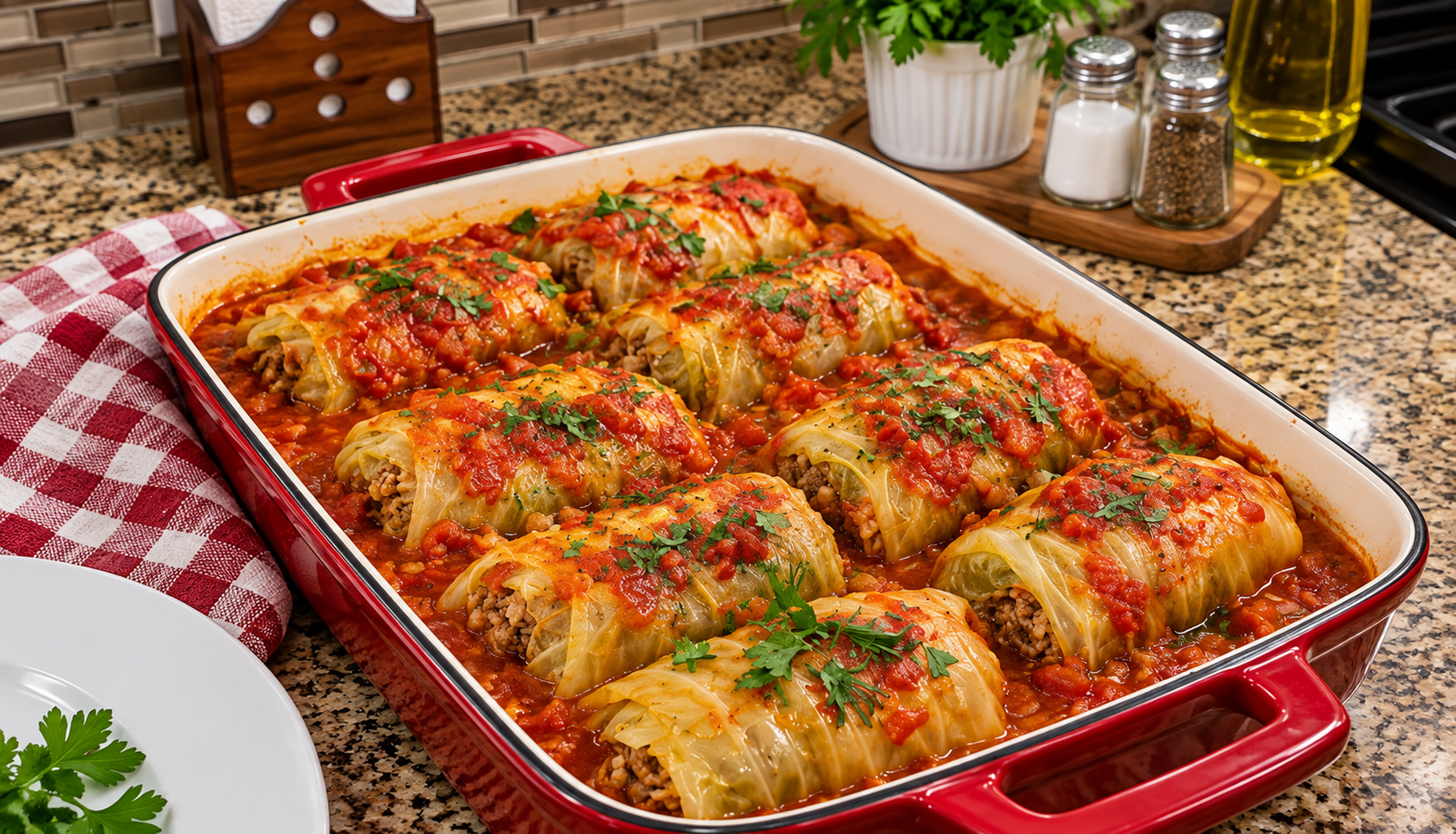
The photo above is the hard-won standard resting on my kitchen counter: eight plump, perfectly tucked cabbage rolls nestled snugly in a bright red ceramic baking dish, coated in a thick, simmering, herb-flecked tomato sauce, garnished with fresh dill and parsley, and ready to be served onto clean white dinner plates.
Here is how you make these classic, melt-in-your-mouth Baked Stuffed Cabbage Rolls at home without a single torn leaf, hard grain of rice, or watery sauce puddle.
Why Cabbage Rolls Fail (The Fiber & Moisture Mechanics)
Making stuffed cabbage rolls is a time-honored craft, but failing to respect vegetable anatomy will ruin your dinner:
1. The Stiff Center Rib (The Unraveling Trap)
Every large cabbage leaf features a thick, woody white spine running down the center. Even after boiling, that spine remains rigid and springs back like a piece of plastic. If you roll a leaf with an intact spine, it will fight the roll, pop open in the oven, and allow the filling to spill into the sauce. Laying each softened leaf flat and using a sharp paring knife to shave down the raised back of the rib (or making a small V-notch at the stem base) makes the entire leaf completely supple and pliable, allowing it to roll as smoothly as a warm flour tortilla.
2. The Raw Rice Sponge Dilemma
Never put completely raw, uncooked white rice into your cabbage roll meat mixture! Raw rice requires high temperatures and a substantial volume of liquid to hydrate. When trapped inside raw ground meat, the dry rice robs the meat of all its natural juices, leaving the beef dry and crumbly while the rice grains often remain crunchy and undercooked. Par-cooking your rice for 8 to 10 minutes (or using leftover chilled rice) ensures the grains are already soft, letting them absorb the savory beef fat without dehydrating the meat.
3. Trapped Steam vs. Oven Drying
Cabbage leaves take 60 to 75 minutes of gentle braising to soften into that sweet, fork-tender texture. If you bake cabbage rolls uncovered, the exposed top leaves dry out in thirty minutes, turning papery, tough, and leathery. Cabbage rolls must be packed tightly side-by-side in a deep baking dish and covered with an airtight seal of foil. This creates an enclosed steam chamber that braises the leaves in tomato moisture, melting plant fibers into buttery perfection.
Ingredients & Tools You’ll Need
Essential Kitchen Gear
- 9×13-Inch Deep Ceramic or Enamel Baking Dish: (A sturdy rectangular baker with handles—like the classic red dish pictured in the photo—holds heat evenly and supports the rolls so they don’t shift).
- Large 8-Quart Stockpot: For par-boiling the whole cabbage head so the leaves peel away effortlessly without tearing.
- 12-Inch Skillet: For sautéing the onions, garlic, and tomato paste before mixing the filling.
- Sharp Paring Knife & Chef’s Knife: For coring the cabbage and shaving down the thick center ribs.
- Large Metal Tongs: For carefully peeling hot, pliable leaves from the boiling cabbage head.
- Heavy-Duty Aluminum Foil: Mandatory for creating that tight, moisture-locking steam seal during the long bake.
The Ingredient Breakdown
| Component | Ingredient | Quantity | Practical Role |
| The Wrappers | Large Green Cabbage or Savoy Cabbage | 1 large head (approx. 3 lbs) | Produces 10 to 12 large, tender, pliable wrapping leaves. |
| The Savory Meat | 80/20 Ground Chuck & Ground Pork Blend | 1.5 lbs total (1 lb beef, ½ lb pork) | Beef provides robust depth; pork fat keeps the filling juicy. |
| The Tender Grain | Long-Grain White Rice | 1 cup (par-cooked and cooled) | Softened grains that absorb internal meat drippings. |
| Aromatic Base | Sweet Yellow Onion | 1 large (very finely diced) | Sautéed in butter to bring sweet moisture to the filling. |
| Aromatic Punch | Fresh Garlic Cloves | 5 cloves (minced, divided) | Infuses both the meat filling and tomato sauce with bistro depth. |
| The Binder | Large Egg | 1 whole (lightly beaten) | Binds the meat, rice, and aromatics into a cohesive, sliceable filling. |
| The Sauté Fat | Unsalted Butter & Olive Oil | 2 tbsp butter, 1 tbsp olive oil | Sweats the onions and blooms the tomato paste. |
| The Sauce Base | Crushed San Marzano Tomatoes | 1 can (28 oz) | Rich, thick, sweet tomato foundation that won’t turn watery. |
| Tomato Engine | Tomato Paste | 2.5 tbsp | Deepens the color, body, and umami of the braising sauce. |
| Sweet-Tart Polish Profile | Apple Cider Vinegar & Dark Brown Sugar | 1.5 tbsp vinegar, 1 tbsp brown sugar | Balances the rich pork fat with classic sweet-and-sour tang. |
| Savory Booster | Worcestershire Sauce | 1.5 tbsp | Adds fermented umami that elevates the ground beef. |
| The Braising Liquid | Low-Sodium Beef Bone Broth | ¾ cup | Thins the tomato sauce just enough to create braising steam. |
| Herbal Backbone | Dried Thyme, Paprika, Italian Herbs | 1 tsp each | Earthy, woodsy seasonings that flavor the meat from within. |
| Base Seasoning | Coarse Kosher Salt & Black Pepper | 1.5 tbsp salt (divided), 1 tbsp cracked pepper | Essential seasoning across cabbage water, meat, and sauce. |
| Fresh Garnish | Fresh Dill & Italian Flat-Leaf Parsley | 2 tbsp each (finely chopped) | Sprinkled over the hot rolls for authentic herbal contrast. |
Step-by-Step Cooking Instructions
Step 1: Core and Par-Boil the Cabbage Leaves
Bring your large 8-quart stockpot of water to a rolling boil over high heat.
Add 1 tablespoon of coarse kosher salt.
Take your whole green cabbage and peel off any damaged outer leaves.
Set the cabbage stem-side up on your cutting board.
Using a sharp, sturdy paring knife, cut a deep, cone-shaped circle around the stem core, cutting roughly 2 inches deep into the cabbage.
Pry out and discard the hard, woody core.
Why Coring First Matters: Removing the core detaches the leaves at their root anchor, allowing boiling water to circulate directly into the center of the head so the leaves slide off cleanly without tearing.
Using large tongs, carefully lower the whole cored cabbage head into the boiling water.
Boil gently for 4 to 6 minutes.
As the hot water loosens the outer leaves, use your tongs to gently peel 10 to 12 large outer leaves away from the head one by one as they soften.
Transfer the softened leaves immediately into a colander in your sink and rinse with cold tap water to stop the cooking.
Step 2: Trim the Ribs and Dry the Leaves
Lay each cooled cabbage leaf flat on a clean cutting board, rib-side facing up.
Notice that thick, raised white vein running down the center.
Hold your small paring knife completely flat against the leaf surface and gently shave down the raised white rib until it is flush and level with the rest of the green leaf.
(Alternatively, cut a small, narrow 1-inch V-notch into the bottom base of the stem to remove the stiffest part).
Lay the trimmed leaves flat across a double layer of paper towels and pat them completely bone-dry.
Dry leaves grip the meat filling firmly and roll without slipping.
Step 3: Sauté the Aromatics and Build the Sauce
Place your 12-inch skillet over medium heat.
Add 2 tablespoons of butter and 1 tablespoon of olive oil.
Toss in the finely diced sweet yellow onion with a pinch of kosher salt.
Cook for 5 minutes, stirring with a wooden spatula, until the onions are soft, translucent, and sweet.
Add the minced garlic and cook for 60 seconds until fragrant.
Spoon half of the cooked onion-and-garlic mixture into a large mixing bowl to cool for the filling.
Leave the remaining onions in the skillet to build the tomato sauce:
- Turn the skillet heat to medium-low.
- Add 2.5 tablespoons of tomato paste and cook against the pan for 90 seconds until it darkens to a brick-red color.
- Pour in the 28-ounce can of crushed tomatoes, ¾ cup of beef bone broth, 1.5 tablespoons of apple cider vinegar, 1 tablespoon of brown sugar, 1.5 tablespoons of Worcestershire sauce, 1 teaspoon of kosher salt, and ½ teaspoon of black pepper.
- Simmer gently for 5 minutes, stirring until smooth, rich, and cohesive. Remove from heat.
Step 4: Mix the Meat and Rice Filling
To the mixing bowl containing your cooled sautéed onions and garlic, add:
- 1 pound of ground chuck
- ½ pound of ground pork
- 1 cup of par-cooked white rice
- 1 lightly beaten large egg
- 1 teaspoon of dried thyme, 1 teaspoon of smoked paprika, and 1 teaspoon of Italian herbs
- 1 teaspoon of coarse kosher salt and 1 teaspoon of coarse cracked black pepper
- ⅓ cup of the prepared warm tomato sauce from your skillet
Using clean hands, gently fold and mix the ingredients together just until evenly combined.
Do not squeeze or overwork the ground meat into a paste!
Gentle mixing ensures the filling remains light, juicy, and tender after baking.
Step 5: Roll the Cabbage Bundles (The Burrito Technique)
Preheat your oven to 350°F (175°C).
Take your red ceramic baking dish.
Spoon about 1 cup of the warm tomato sauce across the bottom of the dish, spreading it into an even, savory layer to cushion the rolls.
Now, assemble your rolls on your cutting board:
- Lay one trimmed cabbage leaf flat with the cut stem edge closest to you.
- Spoon roughly ⅓ to ½ cup of the savory meat-and-rice filling across the lower third of the leaf, shaping it into an even log.
- Fold the bottom stem edge tightly up and over the meat.
- Fold both side edges of the leaf inward over the center, like wrapping a burrito wrapper.
- Roll the cabbage leaf firmly forward away from you until you have a neat, compact, tightly tucked cylinder.
- Repeat until you have 8 to 10 uniform cabbage rolls.
Step 6: Assemble and The Foil Steam-Bake
Nestle the assembled cabbage rolls seam-side down into your prepared red ceramic baking dish, packing them snugly side-by-side in two neat rows (exactly as shown in the reference photo).
Packing the rolls tightly against each other keeps their seams closed so they cannot unroll during baking.
Pour the remaining warm tomato sauce generously over the tops of the cabbage rolls, using a spoon to spread the sauce into every crevice between the bundles.
Tear off a large sheet of heavy-duty aluminum foil.
Cover the red baking dish tightly, crimping the foil firmly around the ceramic handles and edges to seal in all the steam.
Slide the baking dish onto the center rack of your preheated 350°F (175°C) oven.
Bake covered for 75 to 85 minutes.
Why This Long Covered Bake Is Mandatory: Trapped steam circulates through the enclosed dish, forcing hot tomato and meat juices through the cabbage leaf layers. This breaks down tough plant cellulose until the cabbage rolls become tender enough to cut effortlessly with the side of a dull fork.
Step 7: The Uncovered Finish and Rest
Carefully pull the baking dish out of the oven using heatproof mitts and remove the foil (watch out for escaping hot steam!).
Test a roll with a paring knife: the blade should slide cleanly through the cabbage leaf and meat center with zero resistance.
Return the dish to the oven uncovered for 10 to 12 minutes.
This allows the tomato sauce on top of the rolls to reduce, thicken, and caramelize slightly into that glossy, rich, red glaze seen in the photo.
Set the hot red ceramic baker onto a kitchen towel or trivet on your counter.
Scatter freshly chopped dill and Italian parsley generously across the bubbling rolls.
The Mandatory 10-Minute Rest: Do not scoop or serve the rolls immediately!
Straight out of the oven, the rolls are boiling hot and fragile.
During this rest:
- The meat and rice matrix sets into a firm, juicy cake that holds its shape when transferred.
- The cabbage leaves absorb the surrounding tomato jus, becoming silky and sliceable.
- The sauce thickens into a rich, spoonable gravy.
Use a flat metal spatula or serving spoon to lift an intact roll cleanly out of the dish, transferring it directly onto a wide white dinner plate.
Spoon two to three tablespoons of the rich tomato pan sauce all over the top and serve hot!
Practical Troubleshooting & Common Mistakes
- “My cabbage rolls unraveled and fell apart.”
This happens if you didn’t shave down the thick center stem, or if you placed the rolls too loosely in the dish. Always shave down the raised white rib so the leaf bends easily, and pack the rolls snugly seam-side down side-by-side so they support each other. - “The rice inside was hard and crunchy.”
Never use raw white rice! Tomato acid inhibits starch softening, and raw rice will stay hard inside the meat. Always par-boil your rice for 8 to 10 minutes until half-tender before folding it into the ground beef. - “The sauce turned watery.”
Cabbage releases natural moisture as it cooks. Always pat your blanched leaves dry with towels before rolling, and avoid pouring watery canned sauces or excessive broth into the dish. Stick to concentrated crushed tomatoes and tomato paste.
Delicious Upgrades & Variations
While this classic beef and pork tomato-braised recipe is the ultimate Eastern European comfort standard, you can easily customize the dish:
- The Smoked Bacon Blanket: Lay 4 strips of thick-cut smoked bacon directly across the top of the cabbage rolls before sealing with foil. The bacon renders downward into the tomato sauce, adding an incredible smoky campfire depth.
- The Ground Turkey & Mushroom Twist: Lighten the filling by using ground turkey and folding in 1 cup of finely minced sautéed cremini mushrooms for earthy moisture that prevents poultry from drying out.
- The Sweet-and-Sour Raisin Sauce: Stir ¼ cup of golden raisins and a splash of lemon juice into the tomato sauce before pouring it over the rolls for a traditional Jewish-style sweet-and-sour braise.
What to Serve with Baked Cabbage Rolls
These hearty, all-in-one stuffed cabbage rolls deliver protein, vegetables, and rice in every portion, making them a complete meal in a single dish. However, they pair wonderfully with traditional accompaniments:
- A Large Dollop of Cold Sour Cream: The authentic way! Stirring a spoonful of cold, tangy sour cream directly into the warm tomato sauce on your plate creates a luscious, creamy pink gravy that cuts through the rich beef.
- Crusty Rye Bread or Sourdough: Slathered with salted butter, thick crusty bread is mandatory for wiping the plate clean of every drop of savory tomato-meat jus.
- Buttered Boiled Potatoes: Tossed with sea salt and fresh dill, simple waxy yellow potatoes are the classic Polish accompaniment for soaking up extra pan sauce.
- A Crisp Cucumber Dill Salad: Thinly sliced cucumbers tossed in white vinegar and olive oil provide a cool, crunchy, acidic contrast that cleanses the palate between bites.
Storing and Reheating Leftovers (The Next-Day Secret)
Cabbage rolls are widely celebrated because they taste even better on the second and third day.
As the rolls chill in the refrigerator overnight, the tender cabbage leaves continue to absorb the savory garlic, beef, and tomato juices, becoming even sweeter and more cohesive.
Cover the baking dish tightly with foil or transfer individual rolls into an airtight glass container and store in the refrigerator for up to 4 to 5 days.
How to Reheat Properly:
- In the Oven: Place leftover cabbage rolls in a small baking dish with a couple of spoonfuls of tomato sauce. Cover with foil and warm at 350°F (175°C) for 15 to 20 minutes until heated through to the center.
- On the Stovetop: Place the rolls in a covered skillet over medium-low heat with a splash of broth or water. Heat gently for 8 to 10 minutes, spooning the warm sauce over the rolls.
Ladle onto your plate, top with a spoonful of cold sour cream and fresh dill, and enjoy a timeless, soul-warming comfort meal with practically zero effort!