
I will never forget the Sunday night dinner party that almost made me throw my glass casserole dish straight into the recycling bin.
I had invited my in-laws over, determined to make a cozy Italian comfort meal that looked as impressive as a restaurant entree: tender jumbo pasta shells bursting with seasoned shredded chicken and creamy ricotta, blanketed in a rich garlic Alfredo sauce, and baked until bubbling and golden-brown.
I thought I could take every shortcut in the book. I boiled the pasta shells until they were completely soft, mixed cold dry chicken breast directly with cheap tub ricotta, dumped a jar of store-bought Alfredo sauce over the top, tossed on some pre-shredded mozzarella, and shoved the dish into a blazing hot oven.
Forty minutes later, I pulled out a culinary heartbreak.
The tops of the pasta shells had dried out into hard, crunchy plastic chips that cut the roof of your mouth. The jarred Alfredo sauce had broken under the oven’s heat, separating into an unappetizing puddle of translucent yellow oil and grainy white curds at the bottom of the dish.
Worst of all, when my father-in-law cut into a shell, the filling was chalky, dry, and bland—the ricotta had seized up into a rubbery clump around the chicken. Everyone was polite, washing down each dry mouthful with giant gulps of wine, but I spent the entire evening cleaning grease off my glass pan while quietly dying inside.
That dinner disaster sent me down a rabbit hole of pasta mechanics and dairy chemistry. Stuffed jumbo shells are meant to be luxurious, tender, and deeply satisfying. But you cannot treat them like a standard tossed pasta.
The breakthrough came when I realized three things: you must under-cook the pasta shells in the boiling water, you need an egg and a splash of cream inside the filling to keep the ricotta velvety, and you must make a fast stovetop garlic cream sauce that stays rich and cohesive under the heat of the oven.
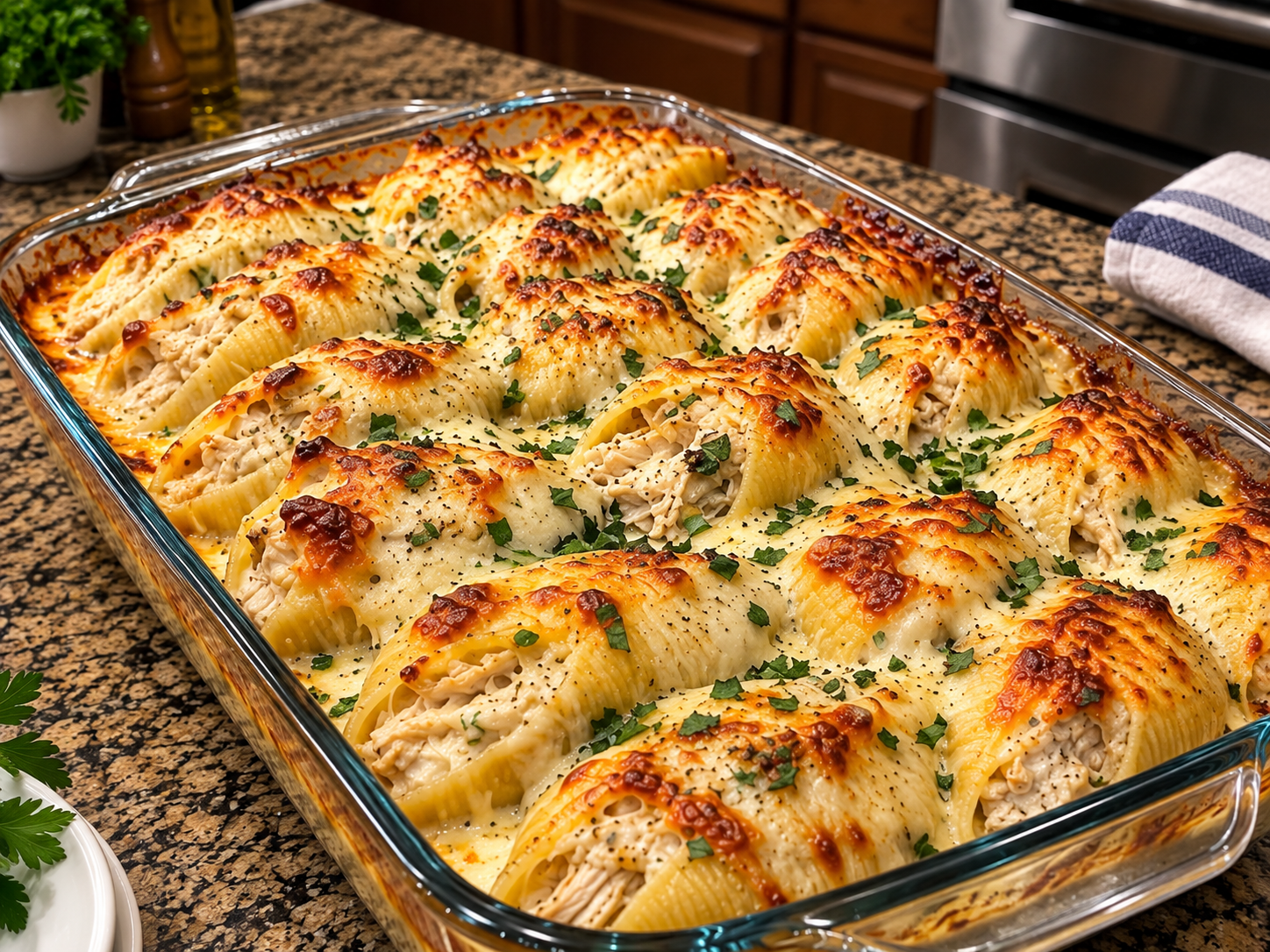
The photo above is the hard-earned victory sitting on my kitchen counter: plump, tender jumbo shells stuffed to the brim with succulent shredded chicken, nestled in a velvety bed of homemade garlic cream sauce, crowned with an edge-to-edge mantle of melted, blistered golden mozzarella and fresh herbs.
Here is how you make this incredible baked chicken Alfredo stuffed shells casserole at home without a single dry or rubbery bite.
Why Baked Stuffed Shells Turn Tough and Dry (The Science)
Baking pasta shells in a dairy sauce inside an oven is a test of moisture management. If your baked shells have ever turned out crunchy or rubbery, here is what happened behind the scenes:
1. The Over-Boiled Shell Trap
Jumbo pasta shells have thick, curved walls. If you boil them according to the standard package directions until they are fully tender, they will completely fall apart when you try to stuff them. Even worse, as they bake in the oven for thirty minutes, they continue to absorb liquid, turning the bottom into mush while the exposed top edges dehydrate into jaw-breaking, rock-hard chips. You must under-boil jumbo shells by 2 to 3 minutes (true al dente). They should be pliable enough to hold open without tearing, but firm enough to hold their boat-like shape and absorb sauce in the oven without getting soggy.
2. Skipping the Ricotta Moisture Binder
Ricotta cheese is high in moisture and milk protein. When baked without a fat cushion, those delicate proteins contract tightly, squeezing out their water and leaving behind a grainy, chalky curd. Whisking a whole egg, a splash of heavy cream, and freshly grated parmesan into the whole-milk ricotta before folding in the chicken creates an emulsion. As the egg gently sets in the oven, it locks in the moisture, keeping the filling as light, fluffy, and tender as a savory cannoli cream.
3. Using Jarred Alfredo Sauce
Commercial jarred Alfredo sauces rely heavily on chemical emulsifiers, soybean oil, and cornstarch rather than real heavy cream and aged cheese. When subjected to 375°F (190°C) oven temperatures for thirty minutes, those artificial stabilizers fail, causing the oil to separate from the water. A quick, ten-minute homemade garlic cream sauce built with real butter, minced fresh garlic, heavy cream, and Parmigiano-Reggiano stays silky, glossy, and cohesive throughout the entire bake.
Ingredients & Kitchen Tools
Essential Gear
- 9×13-Inch Deep Tempered Glass Baking Dish: (A clear glass dish, like the one in the photo, distributes heat evenly and allows you to watch the sauce bubbling along the bottom edges).
- Large 6- to 8-Quart Stockpot: For boiling the jumbo shells with plenty of room so they don’t collide and tear.
- Large Rimmed Baking Sheet Lined with Parchment: Crucial for laying out the boiled shells flat so they don’t stick to each other while cooling.
- Large Mixing Bowl: Roomy enough to fold the chicken, ricotta, and seasonings without shredding the meat into mush.
- Standard Cookie Scoop or Large Spoon: Makes stuffing the shells fast, clean, and uniform.
The Ingredient Breakdown
| Component | Ingredient | Quantity | Practical Role |
| The Pasta Boats | Jumbo Pasta Shells (Conchiglioni) | 24 to 28 shells (about ¾ of a 12 oz box) | Sturdy vehicles that cradle the savory filling. |
| The Savory Meat | Cooked Shredded Chicken Breast or Thighs | 3 cups (approx. 1 lb, cooked) | Juicy, tender protein; store-bought rotisserie chicken works brilliantly. |
| The Filling Base | Whole-Milk Ricotta Cheese | 15 oz (1 tub, well-drained) | Delivers a rich, creamy, traditional Italian filling texture. |
| The Filling Binder | Large Egg | 1 whole (lightly beaten) | Binds the cheese matrix so it bakes up fluffy, not runny or grainy. |
| The Filling Cheese | Low-Moisture Whole-Milk Mozzarella | 2.5 cups (freshly shredded, divided) | Melts into gooey pockets inside the filling and creates the golden top crust. |
| The Filling Cheese | Aged Parmigiano-Reggiano | 1 cup (freshly grated, divided) | Delivers sharp, salty, authentic umami depth to filling and sauce. |
| The Sauce Fat | Unsalted Butter | 4 tbsp (half a stick) | Sauté medium for the garlic and base of the cream reduction. |
| Aromatic Punch | Fresh Garlic | 5 to 6 cloves (finely minced) | Delivers that classic steakhouse garlic Alfredo aroma. |
| The Sauce Cream | Heavy Whipping Cream | 2 cups | Forms the luxurious, silky, unbroken sauce foundation. |
| The Sauce Broth | Low-Sodium Chicken Bone Broth | ½ cup | Thins the heavy cream slightly so the pasta has liquid to absorb. |
| Herbal Lift | Fresh Italian Flat-Leaf Parsley | 3 tbsp (finely chopped, divided) | Fresh herbal balance that cuts through the rich dairy. |
| Warm Spice | Ground Nutmeg | ⅛ tsp (just a pinch) | The secret Italian bistro note that elevates white cream sauces. |
| Seasoning | Garlic Powder & Italian Seasoning | 1 tsp each | Disperses savory herbal depth evenly into the chicken filling. |
| Base Seasoning | Coarse Kosher Salt & Cracked Pepper | 1.5 tsp salt, 1 tsp coarse black pepper | Crucial seasoning across the pasta water, filling, and sauce. |
Step-by-Step Cooking Instructions
Step 1: Boil and Cool the Jumbo Shells (The Anti-Tear Trick)
Bring a large 6- to 8-quart stockpot of water to a vigorous, rolling boil over high heat.
Add 2 generous tablespoons of coarse kosher salt.
Drop in 28 to 30 jumbo shells (always boil 4 or 5 extra shells than you need, because a couple will inevitably tear or split in the box).
Stir gently with a wooden spoon for the first 60 seconds so the shells don’t settle and stick to the bottom of the pot.
Look at the package directions for al dente: set your kitchen timer for 3 minutes LESS than the lowest recommended time (usually around 9 to 10 minutes total).
The shells should be pliable and bendable, but still feel noticeably firm to the bite.
Drain the shells immediately into a colander and rinse them with cool tap water for 30 seconds to halt the cooking process.
Line a large rimmed baking sheet with parchment paper.
Pick up each shell and arrange them open-side down in a single layer on the baking sheet to drain completely.
Cook’s Real-Life Tip: Never leave warm boiled shells sitting inside a colander! As they sit touching each other, the cooling starches will glue them together into a giant clump. When you try to pull them apart, the delicate walls will rip. Spreading them out on a sheet pan keeps them completely separate and easy to handle.
Step 2: Whisk the Fluffy Ricotta Chicken Filling
In your large mixing bowl, combine:
- 15 ounces of whole-milk ricotta
- 1 lightly beaten large egg
- 1 cup of freshly shredded mozzarella
- ½ cup of freshly grated Parmigiano-Reggiano
- 2 tablespoons of heavy cream
- 1 teaspoon of garlic powder
- 1 teaspoon of dried Italian seasoning
- 1 teaspoon of coarse kosher salt
- ½ teaspoon of freshly cracked black pepper
- 2 tablespoons of finely chopped fresh parsley
Whisk vigorously with a fork or silicone spatula until the mixture is light, creamy, and uniform.
Now, add your 3 cups of shredded cooked chicken.
Gently fold the chicken into the seasoned cheese mixture using your spatula until every shred of poultry is coated in the creamy binder.
Taste the mixture (before adding the raw egg if you prefer, or just trust your seasoning balance): it should taste rich, savory, and well-salted.
Step 3: Simmer the 10-Minute Garlic Alfredo Sauce
Preheat your oven to 375°F (190°C).
Place a large 12-inch skillet or saucepan over medium heat.
Melt the 4 tablespoons of unsalted butter until foaming.
Add the minced fresh garlic and cook for 60 to 90 seconds, stirring constantly.
You want the garlic intensely fragrant and soft—do not let it turn brown, or it will impart a bitter flavor to your white cream sauce!
Pour in the 2 cups of heavy whipping cream and ½ cup of low-sodium chicken broth.
Stir in a pinch of ground nutmeg, ½ teaspoon of kosher salt, and ½ teaspoon of black pepper.
Bring the liquid to a gentle, bubbling simmer over medium-low heat.
Let it simmer for 4 to 5 minutes, stirring frequently, until it reduces slightly and coats the back of a spoon.
Remove the skillet from the heat source completely.
Gradually whisk in the remaining ½ cup of freshly grated Parmigiano-Reggiano, a handful at a time, whisking until the cheese melts into a silky, unbroken, velvety sauce.
Step 4: The Pan Foundation
Take your 9×13-inch glass baking dish.
Ladle roughly one cup of the warm garlic Alfredo sauce directly into the bottom of the dish.
Use the back of your ladle to spread the sauce into a smooth, even pool covering the entire glass base.
This bottom layer of sauce is non-negotiable: it provides the essential moisture cushion that steams the underside of the pasta shells into melt-in-your-mouth tenderness while preventing the pasta from scorching or sticking to the glass.
Step 5: Stuff and Pack the Shells
Using a standard medium cookie scoop (or two large soup spoons), scoop a generous portion of the chicken ricotta filling—about 2 to 3 tablespoons—into each cooked jumbo shell.
Fill them generously so the meat and cheese mounded slightly over the top edges.
Nestle the stuffed shells into the prepared baking dish in neat, snug rows, open-side facing up (exactly like the beautiful arrangement in the reference photo).
Pack them tightly against each other: snug shells support each other’s walls, preventing the filling from slumping out during the bake.
A standard 9×13 dish fits roughly 20 to 24 stuffed shells perfectly.
Step 6: Sauce, Cheese, and the Two-Stage Bake
Pour the remaining warm garlic Alfredo sauce evenly over the tops of the stuffed shells, making sure some sauce drizzles into the seams and over the exposed pasta edges to keep them hydrated.
Now, blanket the entire casserole with the remaining 1.5 cups of freshly shredded whole-milk mozzarella cheese.
Sprinkle a light dusting of coarse black pepper and a pinch of dried Italian herbs across the cheese.
Tear off a sheet of aluminum foil and lightly mist the shiny side with nonstick cooking spray (this prevents the melting cheese from sticking to the foil).
Cover the baking dish tightly with the foil.
- The Covered Bake: Slide the dish onto the center rack of your preheated 375°F (190°C) oven and bake for 20 minutes. The trapped steam inside the foil heats the chicken filling through to the center, gently cooks the egg binder, and softens the pasta shells into true al dente perfection.
- The Golden Uncovered Finish: Remove the foil completely. Return the dish to the oven for another 10 to 12 minutes until the sauce is bubbling vigorously around the perimeter and the cheese is fully melted.
- The Broiler Char: For that restaurant-style blistered look in the photo, turn the oven to BROIL (High) for the final 2 minutes. Watch through the oven window like a hawk: the mozzarella will puff up, bubble aggressively, and brown into savory, caramelized golden blisters. Pull the dish out the moment the top looks toasted and bronzed.
Step 7: The Mandatory 10-Minute Rest
Set the hot glass baking dish on a wooden cutting board or heatproof trivet on your kitchen counter.
Scatter the remaining finely chopped fresh Italian parsley across the bubbling, melted cheese.
The Non-Negotiable Rule: Do not attempt to scoop or serve these shells immediately!
Straight out of the oven, the Alfredo sauce is boiling and thin, and the melted cheese is molten liquid.
If you plunge a spatula into the dish right now, the shells will slide apart, and the sauce will run like water across the plate.
Let the casserole rest undisturbed on the counter for 10 full minutes.
During this rest:
- The starches in the pasta settle and pull in the surrounding garlic cream.
- The Alfredo sauce cools down from boiling-hot to a rich, luscious, spoon-coating gravy.
- The melted mozzarella sets into a cohesive, stretchy blanket that lifts cleanly with every portion.
Use a flat metal spatula to lift three or four shells per person onto wide plates, ladling extra creamy sauce from the bottom of the dish over each serving.
Practical Troubleshooting & Common Mistakes
- “The edges of my shells turned hard and crunchy.”
This happens if you skip covering the dish with foil for the first 20 minutes, or if you didn’t spoon enough sauce over the exposed pasta rims before baking. The foil traps steam, which hydrates the outer pasta walls while the center cooks through. - “The sauce separated into yellow oil at the bottom.”
This is the classic hallmark of either using pre-shredded bagged mozzarella (which contains potato starch and anti-caking additives) or letting the casserole boil too violently on the bottom rack. Always buy whole-milk block mozzarella and block parmesan, shred them yourself on a box grater, and bake on the middle oven rack. - “The chicken filling tasted dry or grainy.”
This occurs when home cooks use low-fat or skim ricotta without an egg binder. Part-skim ricotta lacks the butterfat needed to withstand oven heat, breaking down into watery chalk. Always buy whole-milk ricotta, drain any excess water sitting on top of the tub, and whisk in that single egg to lock in moisture.
Delicious Flavor Twists & Upgrades
While this garlic chicken Alfredo combination is the ultimate comfort classic, you can easily adapt the filling to match what you have on hand:
- The Florentine Twist (Spinach & Chicken): Squeeze all excess water out of 10 ounces of thawed frozen chopped spinach (or sauté fresh baby spinach in butter) and fold it directly into the chicken ricotta filling for an extra boost of earthy flavor and vibrant green color.
- The Crispy Bacon Upgrade: Fry 6 strips of thick-cut smoked bacon until crispy, chop them into fine bits, and fold half into the filling while scattering the rest over the mozzarella before broiling.
- Sun-Dried Tomato & Basil: Fold ½ cup of oil-packed sun-dried tomatoes (finely diced) into the filling for a sweet, tangy Mediterranean punch that cuts through the rich cream sauce.
What to Serve with Chicken Alfredo Stuffed Shells
Because this baked pasta is rich, savory, and decadent, it pairs naturally with bright, crisp accompaniments that cleanse the palate:
- A Crisp Caesar or Italian Chopped Salad: Crisp romaine lettuce, shaved parmesan, crunchy croutons, and a tangy lemon-garlic or vinaigrette dressing provide a cool, crunchy contrast to the warm, bubbling pasta.
- Warm Garlic Bread or Focaccia: Essential for swiping through the bottom of your plate to catch every last drop of homemade garlic Alfredo sauce.
- Steamed Broccoli or Roasted Asparagus: Tossed simply with olive oil, sea salt, and a squeeze of fresh lemon juice, crisp-tender green vegetables balance the rich, cheesy cream.
- A Dry, High-Acid White Wine: A chilled glass of Italian Pinot Grigio, Gavi, or an un-oaked Sauvignon Blanc cuts right through the rich butter and heavy cream.
Make-Ahead Instructions & Reheating Leftovers
This is one of the absolute best pasta casseroles to assemble ahead of time for busy weeknights or stress-free entertaining:
How to Make Ahead:
- Boil the shells, mix the filling, stuff them, and assemble the casserole completely in your glass baking dish through Step 5.
- Pour the Alfredo sauce over the shells, but leave the mozzarella off for now.
- Cover the dish tightly with plastic wrap and aluminum foil, and refrigerate for up to 24 hours.
- When ready to bake, pull the dish out of the refrigerator 30 minutes beforehand to take the deep chill off the glass (cold glass in a hot oven can shatter).
- Top with the shredded mozzarella, cover with greased foil, and bake at 375°F for 30 minutes covered, then uncover and bake for 10 to 12 minutes until bubbling and golden-brown.
Handling Leftovers:
Store any leftover stuffed shells in an airtight glass container in the refrigerator for up to 4 days.
When reheating, avoid blasting them dry in the microwave on high heat, which can separate the cream sauce.
Instead, place your leftover shells in a small oven-safe dish, splash 2 tablespoons of milk or chicken broth around the base to revive the sauce, cover loosely with foil, and warm in a 350°F (175°C) oven or toaster oven for 15 minutes. The sauce will turn silky and smooth again, the mozzarella will melt into gooey ribbons, and the chicken filling will stay just as juicy as the day you baked it.