
I will never forget the holiday dinner party that nearly broke my culinary spirit in front of eight hungry guests.
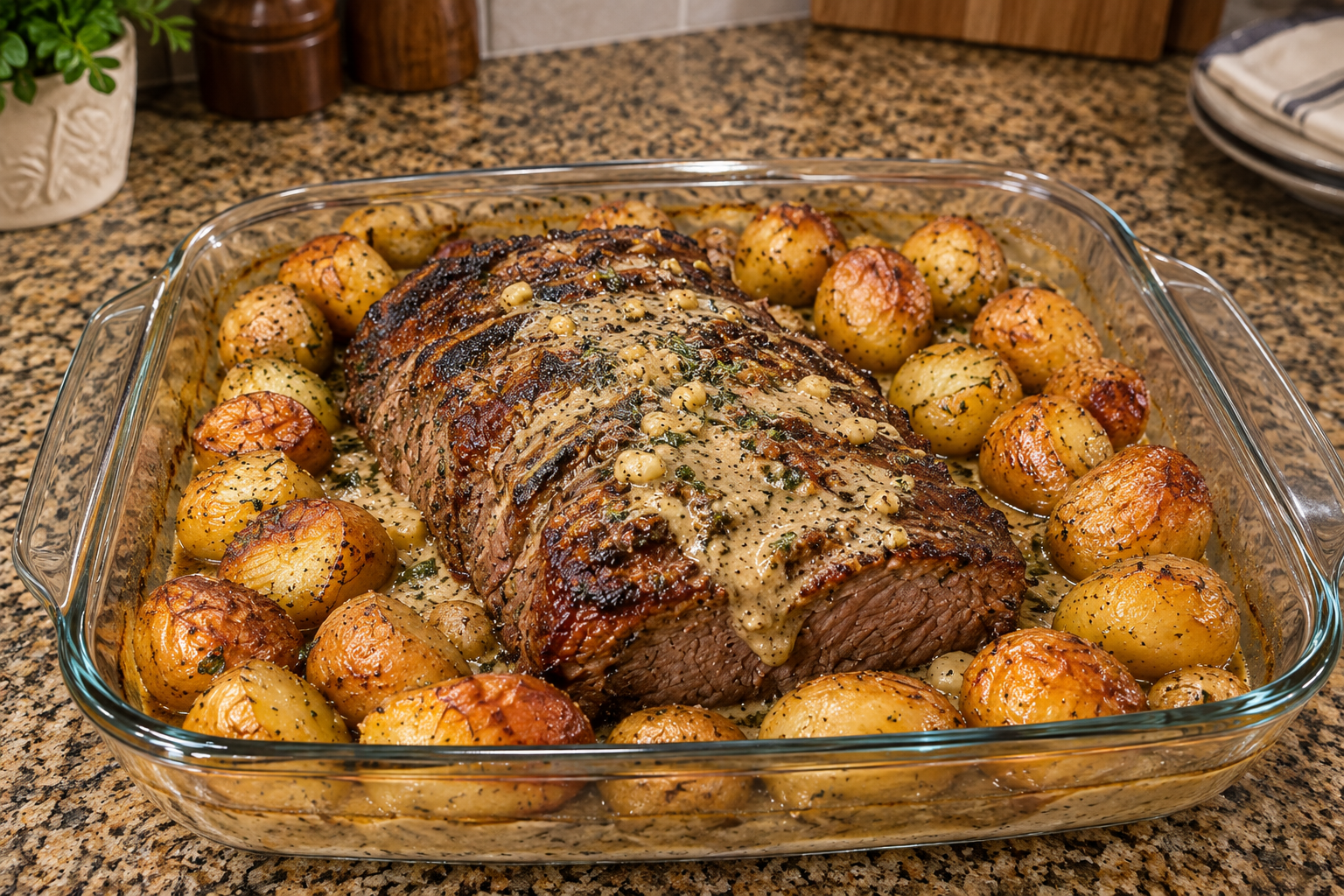
I had saved up for weeks to buy a prime center-cut beef tenderloin roast. In my mind, I was going to carry a restaurant-quality centerpiece to the table: an evenly seared, herb-crusted beef roast resting in a glass baking dish, surrounded by golden, crispy little roasted potatoes, draped in a rich, velvety garlic-herb butter sauce.
I thought I could just toss everything together into one pan and roast it all at the same time. I seasoned the cold beef straight out of the fridge, surrounded it with raw, halved baby gold potatoes, drizzled melted butter and garlic over the entire dish, and shoved the glass casserole straight into a 400°F oven.
Forty-five minutes later, my dream dinner was an absolute catastrophe.
The cold roast had dumped an ocean of surface moisture into the bottom of the glass dish as it heated. Instead of the potatoes roasting into crispy, golden-edged nuggets, they were boiling in a lukewarm pool of beef juices and melted butter, turning pale, waterlogged, and mushy.
Even worse, the beef cooked entirely unevenly: the outer inch was grey, tough, and overdone, while the core was cold and chewy. When I tried to carve a slice at the table, my knife squished the meat, squeezing out what little internal juice was left. My guests were kind enough to swallow each bite with big gulps of red wine, but I spent the rest of the night hiding out by the kitchen sink, completely devastated.
That dinner disaster taught me an invaluable lesson in kitchen physics. A whole beef tenderloin is the leanest, most delicate, and most expensive cut on the steer. It has virtually zero forgiving marbling. If you treat it like a fatty pot roast, it will dry out instantly.
More importantly, potatoes and lean beef cook at completely different speeds and require completely different moisture environments. You cannot roast them together from raw without compromising one or both.
After multiple test runs, tweaking the sear-and-roast timing, par-cooking the baby golds to get that buttery fondant texture, and mastering a velvety garlic herb butter reduction, I finally perfected the method.
The photo above is the hard-won masterpiece on my granite counter: a deeply browned, perfectly roasted beef tenderloin sliced like warm butter, flanked by golden-crusted, tender baby potatoes, all bathed in an aromatic garlic, thyme, and rosemary pan sauce that clings to every single forkful.
Here is how you nail this show-stopping beef tenderloin and roasted potato dinner at home without overcooking the meat or ending up with soggy spuds.
Why Roasting Beef Tenderloin with Potatoes Goes Wrong (The Science)
Pairing a high-end roast with roasted potatoes in a single glass casserole dish is an exercise in heat and moisture management. Here is why standard recipes fail:
1. The Surface Moisture Steam Trap
Raw meat and raw potatoes both contain high levels of surface water. When placed in a deep glass dish together, that moisture evaporates, hits the glass walls, and condenses into liquid at the bottom of the pan. Potatoes need dry, high radiant heat to form a crisp, golden crust; sitting in liquid turns them into boiled, rubbery starch. Par-boiling the potatoes and searing them flat-side down first ensures they develop that crispy exterior before meeting the pan juices.
2. Cooking Cold Beef Straight from the Fridge
If you drop a cold, 38°F roast into a hot oven, the heat struggles to penetrate the dense center. By the time the internal core hits a safe medium-rare (130°F to 135°F), the exterior band of meat has spent too long under high heat, turning grey, dry, and stringy. Tempering the roast on the counter for 45 to 60 minutes before cooking ensures the heat glides through the meat evenly from edge to center.
3. Searing in Glass vs. Cast Iron
Glass baking dishes cannot sear meat. Glass is a terrible conductor of rapid heat compared to metal. If you put raw beef in a glass dish, you will never get that dark, savory Maillard crust that builds steakhouse flavor. Searing the beef hard in a screaming-hot skillet on the stovetop first locks in flavor and color; the glass dish is used solely for the gentle finishing roast.
Ingredients & Tools You’ll Need
Essential Gear
- 9×13-Inch Heavy Tempered Glass Baking Dish: (A clear baking dish, like the one in the photo, holds the heat gently during the final roast and makes a gorgeous presentation at the dining table).
- 12-Inch Cast-Iron or Stainless-Steel Skillet: Mandatory for getting that deep, caramelized sear on the roast and crisping the cut side of the potatoes.
- Digital Instant-Read Probe Thermometer: (A ThermoWorks ThermoPop or similar digital probe is non-negotiable; pull tenderloin strictly by internal temperature, never by the clock).
- Long Slicing Knife & Carving Fork: A razor-sharp, non-serrated blade glides through the tender muscle fibers without tearing or squeezing out juices.
- Butcher’s Kitchen Twine: For tying the roast into a uniform cylinder so it cooks evenly from end to end.
The Ingredient Breakdown
| Component | Ingredient | Quantity | Practical Role |
| The Star Beef | Center-Cut Beef Tenderloin (Chateaubriand) | 2.5 to 3 lbs (trimmed and tied) | The most tender, melt-in-your-mouth cut; requires gentle roasting. |
| The Crispy Spuds | Baby Dutch Yellow or Yukon Gold Potatoes | 1.5 lbs (halved lengthwise) | Creamy, waxy interior; roasts into golden, crisp-edged nuggets. |
| The Searing Fat | High-Smoke-Point Oil (Avocado or Grapeseed) | 2 tbsp | Withstands high skillet heat to create a hard Maillard crust. |
| The Butter Bath | Unsalted Butter | 6 tbsp (divided) | Enriches the pan sauce and gives the potatoes a velvety fondant finish. |
| Aromatic Core | Fresh Garlic Cloves | 6 to 7 cloves (minced or crushed) | Sautéed gently in butter to build that signature steakhouse aroma. |
| Fresh Herbs | Fresh Rosemary | 2 tbsp (finely chopped) | Woodsy, robust herb that pairs naturally with seared beef. |
| Fresh Herbs | Fresh Thyme Leaves | 2 tbsp (finely chopped) | Delicate, floral herbal backbone for the garlic butter pan sauce. |
| Pan Jus Liquid | Low-Sodium Beef Bone Broth | ¾ cup | Loosens the garlic butter into a glossy sauce that won’t separate. |
| Savory Boosters | Worcestershire Sauce | 1 tbsp | Adds fermented umami depth that elevates the lean tenderloin. |
| Savory Boosters | Dijon Mustard | 1 tsp | Mild emulsifier that ties the garlic butter and broth together smoothly. |
| Base Seasoning | Coarse Kosher Salt & Cracked Black Pepper | 1.5 tbsp coarse salt, 1 tbsp coarse black pepper | Crucial seasoning across the surface of the meat and potatoes. |
| Finishing Touch | Flaky Sea Salt (Maldon) | To taste | Sprinkled across the carved slices right before serving. |
Step-by-Step Cooking Instructions
Step 1: Temper, Trim, and Tie the Beef
Take your beef tenderloin out of the refrigerator 45 to 60 minutes before cooking.
If your butcher hasn’t done so, use a sharp paring knife to slice away any tough white connective tissue (silverskin) from the surface.
Tuck the thinner tapered end underneath so the roast forms a uniform cylinder.
Tie the roast firmly with butcher’s twine every 1.5 inches.
Tying keeps the meat round and compact, ensuring that every slice from end to end cooks to the exact same temperature.
Pat the entire surface of the roast completely bone-dry with paper towels.
Rub 1 tablespoon of olive or avocado oil over the meat, then coat it aggressively with 1 tablespoon of coarse kosher salt and 1 tablespoon of freshly cracked coarse black pepper, pressing the spices firmly into the meat.
Step 2: Par-Cook and Crisp the Potatoes
While the meat tempers, place your halved baby yellow potatoes in a medium saucepan.
Cover with cold water and add 1 teaspoon of kosher salt.
Bring to a boil over high heat, then reduce to medium and simmer for 8 to 10 minutes until just barely fork-tender.
Drain the potatoes thoroughly in a colander and let them sit for 5 minutes so steam evaporates off the surface.
Heat a 12-inch cast-iron skillet over medium-high heat with 1 tablespoon of oil and 1 tablespoon of butter.
Place the potatoes cut-side down in the hot skillet.
Sear untouched for 4 to 5 minutes until the cut surfaces develop a deep, blistered, golden-brown crust.
Transfer the crisped potatoes into your 9×13-inch glass baking dish, arranging them in neat rows along the perimeter of the dish, leaving the center wide open for the roast.
Step 3: The Screaming-Hot Skillet Sear
Preheat your oven to 425°F (220°C).
Wipe out any loose potato crumbs from your cast-iron skillet and return it to high heat with 1 tablespoon of high-smoke-point oil.
When you see a light wisp of smoke, carefully lay the seasoned beef tenderloin into the skillet.
You should hear an immediate, violent sizzle.
Sear untouched for 2 to 3 minutes per side.
Use heavy metal tongs to roll the roast, searing all four sides plus the end caps until a rich, dark mahogany crust covers the entire cut of beef.
This step builds nearly all the exterior flavor and takes roughly 8 to 10 minutes total.
Transfer the seared roast directly into the center of your prepared glass baking dish, nestling it right between the rings of golden potatoes (exactly as seen in the photo).
Step 4: Build the Garlic-Herb Butter Sauce
Turn the skillet heat down to medium-low.
Add the remaining 5 tablespoons of butter directly into the pan drippings.
Toss in the minced fresh garlic, chopped fresh rosemary, and chopped fresh thyme.
Cook gently for 60 to 90 seconds, stirring constantly with a wooden spoon.
Do not let the garlic brown! You want it soft, sweet, and fragrant.
Whisk in the ¾ cup of beef bone broth, 1 tablespoon of Worcestershire sauce, and 1 teaspoon of Dijon mustard.
Let the liquid bubble gently for 2 minutes, scraping up any savory browned beef fond from the bottom of the pan until it forms a glossy, emulsified garlic-herb pan jus.
Remove from heat.
Ladle roughly one-third of the warm garlic herb butter directly over the seared beef tenderloin in the glass dish, and spoon another third over the surrounding golden potatoes.
Reserve the remaining third in the pan to keep warm for table service.
Step 5: The Gentle Finishing Roast
Slide the glass baking dish onto the center rack of your preheated 425°F (220°C) oven.
Roast uncovered for 18 to 22 minutes.
Around the 18-minute mark, slide the probe of your digital instant-read thermometer into the thickest center of the roast:
- Rare: Pull at 120°F to 122°F (carries over to 125°F).
- Medium-Rare (The Gold Standard): Pull at 128°F to 130°F (53°C to 54°C) (carries over to a perfect 135°F).
- Medium: Pull at 135°F to 138°F (carries over to 142°F).
Important Cook’s Rule: Never cook beef tenderloin past medium! Because this cut lacks internal marbling fat, cooking it past 140°F will permanently dry out the meat fibers, turning your expensive roast chalky and tough.
The moment your thermometer hits 130°F, pull the entire glass dish out of the oven immediately.
Step 6: The Mandatory 15-Minute Rest
Set the hot glass dish onto a wooden cutting board or heatproof trivet on your kitchen counter.
The Non-Negotiable Rule: Do not touch this roast with a carving knife right now!
Under high roasting heat, the juices inside the beef are pressurized and driven toward the center.
If you slice into the tenderloin immediately, those juices will gush straight out into the pan, leaving the interior meat dry and pale.
Let the dish rest undisturbed on the counter for 12 to 15 full minutes.
During this rest:
- Carryover heat gently finishes cooking the center to a rosy, blush-pink medium-rare.
- The muscle proteins relax and pull the flavorful juices back into the cellular structure of the beef.
- The roasted potatoes soak up the garlicky, herb-infused pan drippings from the bottom of the glass dish, turning creamy and melt-in-your-mouth tender like traditional French fondant potatoes.
Step 7: Carve and Table Presentation
Snip and discard the butcher’s twine from the roast.
Using a long, razor-sharp carving knife and a carving fork (just like the hands-on carving action in the reference photo), carve the tenderloin into thick, succulent slices—roughly ½-inch to ¾-inch thick.
Notice how the knife glides effortlessly through the beef with zero resistance.
Spoon the remaining warm garlic herb butter sauce generously over the carved meat and the glistening potatoes.
Finish with a light sprinkle of flaky Maldon sea salt and fresh black pepper, and serve straight from the warm glass dish right in the middle of the table.
Practical Troubleshooting & Common Mistakes
- “My potatoes turned out soggy and waterlogged.”
This happens if you skip par-boiling and pan-searing the potatoes beforehand. Raw potatoes release moisture into the pan, which boils them instead of roasting them. Par-cooking and giving them a hard skillet sear first seals the cut face, keeping them crisp and golden even as they sit in the garlic butter. - “The meat has a thick grey band around the pink center.”
This is the hallmark of roasting cold beef straight from the fridge. Always let your tenderloin sit on the counter for at least 45 minutes to take the chill off before searing. That allows the heat to cook the meat uniformly from the edge to the center. - “The garlic butter sauce separated into grease.”
Butter breaks into oil if boiled too hard or mixed with cold liquid. Whisking in the beef bone broth and Dijon mustard creates a stable emulsion that holds the melted butter, garlic, and fresh herbs in a silky suspension that coats the back of a spoon.
What to Serve with Garlic Herb Beef Tenderloin
This show-stopping roast is rich, elegant, and savory, making it the perfect centerpiece for holiday dinners and celebration meals:
- Creamed Spinach or Braised Asparagus: A classic steakhouse pairing; the earthy, tender greens cut through the richness of the butter and beef.
- A Peppery Arugula Salad: Baby arugula tossed with shaved parmesan, candied pecans, and a sharp lemon-dijon vinaigrette cleanses the palate between rich bites.
- Crusty Sourdough or Brioche Dinner Rolls: Essential for swiping through the bottom of the glass baking dish to mop up every drop of that garlic, herb, and beef butter sauce.
- A Full-Bodied Red Wine: Pour a bold Cabernet Sauvignon, Bordeaux, or Syrah. The rich tannins in the wine bond beautifully with the lean protein and garlic butter.
Handling Leftovers (The Gentle Reheat Secret)
If you have leftover tenderloin and roasted potatoes, transfer them to an airtight glass container and store in the refrigerator for up to 3 days.
Never microwave beef tenderloin on high power! The microwave will instantly cook the rosy center into grey, dry leather.
Instead, use the gentle oven method:
- Arrange leftover beef slices and potatoes in a small baking dish.
- Spoon a splash of beef broth and a pat of butter over the meat.
- Cover the dish tightly with aluminum foil to lock in steam.
- Warm in a 300°F (150°C) oven for 10 to 12 minutes just until warm to the touch.
The beef will stay juicy and pink, the potatoes will remain creamy, and you will get to enjoy an elite restaurant-level meal all over again. Cold leftover slices also make the absolute greatest shaved roast beef sandwiches on toasted sourdough with horseradish mayo you will ever taste in your life.