
I still cringe thinking about the first time I made beef brisket for a family dinner.
I had dropped serious money at the butcher counter for a gorgeous flat-cut brisket, feeling convinced that slow cookers were magical boxes where you just throw in meat, walk away, and return to steakhouse-level tenderness. I dumped in the slab of beef cold from the fridge, poured a cup of water and a packet of onion soup mix over it, clamped the lid on high, and went to run errands.
Eight hours later, I uncovered what can only be described as a giant slab of salted shoe leather.
Because brisket is packed with dense, tightly wound collagen fibers, blasting it on high heat had seized the proteins before they had a chance to gently melt. When I tried to carve it, the meat fought back against my knife. When we tried to chew it, my brother actually took a sip of water after every single bite just to choke it down. It was tough, stringy, and grey. I was mortified.
That humiliating dinner kicked off an obsession. Brisket is one of the most rewarding cuts of beef on the planet when treated with respect, but it does not forgive shortcuts.
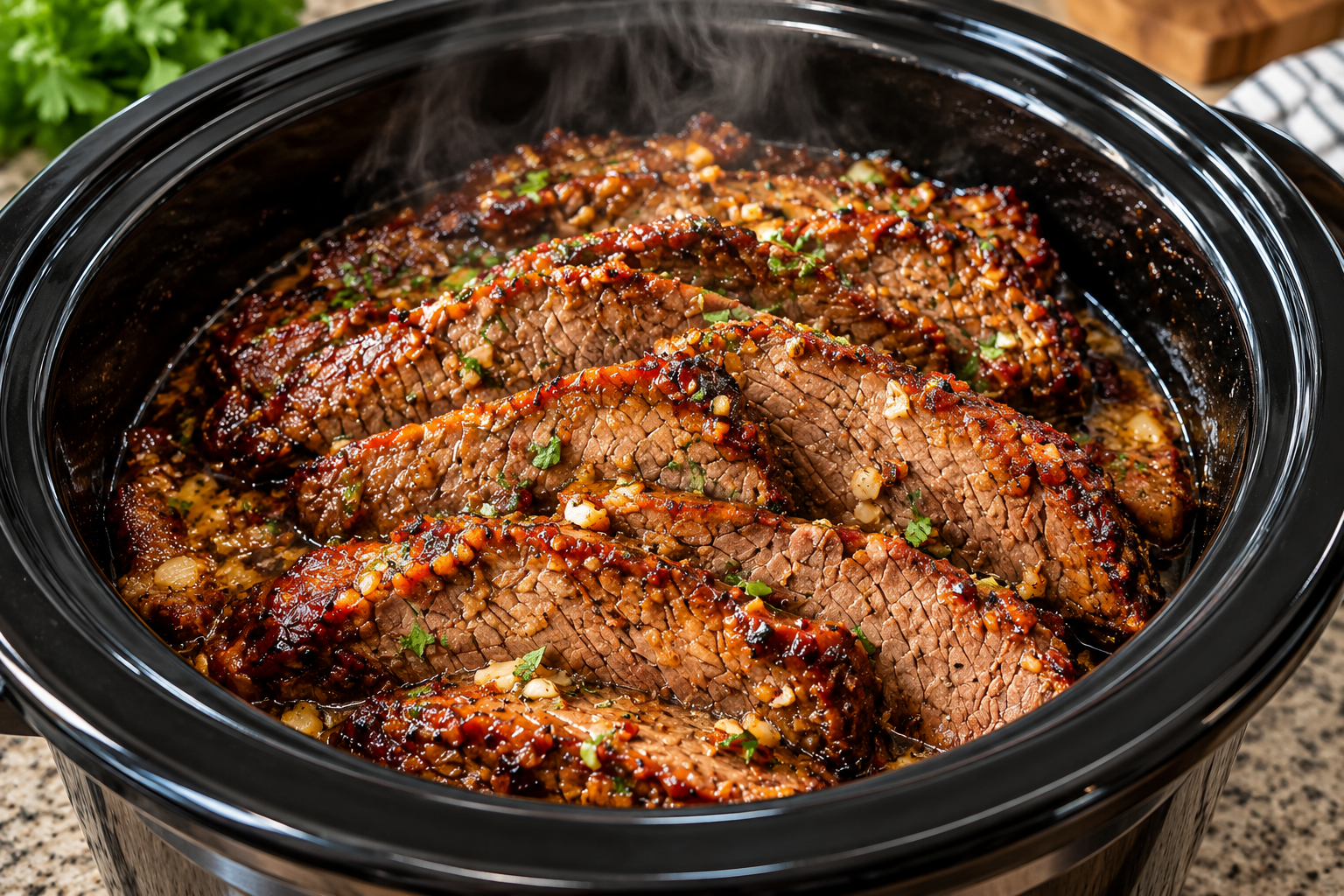
Over the years, after countless butcher shop conversations, liquid ratio adjustments, and temperature tests, I cracked the code. The photo above shows the glorious standard: thick, succulent slices of deeply braised beef brisket resting in a pool of caramelized onion and garlic jus, fork-tender enough to pull apart with zero effort, yet holding clean, gorgeous carving lines.
Here is how you make melt-in-your-mouth slow-cooker beef brisket at home without chewing on dry leather ever again.
Why Brisket Fails in a Slow Cooker (The Kitchen Science)
Beef brisket comes from the breast/pectoral muscle of the steer. It is a working muscle, which means it is loaded with dense connective tissue (collagen) and strong grain lines. If your brisket ends up dry or tough, it almost always comes down to these three mistakes:
1. Cooking on High Heat
Collagen doesn’t instantly soften under intense heat; it contracts. If you cook brisket on the “High” setting of a slow cooker, the meat boils, forcing all intramuscular moisture out into the liquid before the collagen has time to break down into silky gelatin. Brisket requires sustained, low, gentle radiant heat—Low setting only—over 8 to 9 hours to relax the muscle fibers into buttery tenderness.
2. Slicing with the Grain Instead of Against It
You can cook a brisket to absolute perfection, but if you slice it in the wrong direction, every mouthful will feel stringy and chewy. Brisket muscle fibers run in long, parallel strands. Slicing with the grain leaves those long cords intact in your mouth. Slicing perpendicular (across) the grain shears those long fibers into tiny, delicate pieces that fall apart the second your teeth touch them.
3. Slicing the Meat While Boiling Hot
When meat leaves the braising pot, its internal juices are thin, agitated, and under pressure. If you carve a steaming-hot brisket the second you pull it from the crock, all that flavorful moisture bleeds onto the cutting board, leaving the slices grey and parched within minutes. Letting the meat rest, slicing it warm, and returning the thick slices to the savory braising liquid to soak up the juices is the true secret behind juicy results.
Ingredients & Tools You’ll Need
Essential Kitchen Gear
- 6- to 7-Quart Oval Slow Cooker: (An oval Crockpot or slow cooker, like the black ceramic insert pictured, gives a long brisket flat plenty of room to lay flat without bunching up).
- 12-Inch Cast-Iron Skillet: For giving the exterior of the brisket a hard 3-minute sear before braising.
- Large Chef’s Knife or Granton-Edge Slicing Knife: Essential for carving clean, uniform slices without tearing the tender meat fibers.
- Tongs and Meat Forks: To lift the tender meat out of the cooker safely.
The Ingredient Breakdown
| Component | Ingredient | Quantity | Practical Role |
| The Star | Beef Brisket (Flat Cut with Fat Cap) | 3.5 to 4.5 lbs (1.6 to 2 kg) | The ideal cut for clean, uniform slicing; leave ¼-inch fat cap intact. |
| Dry Rub | Smoked Paprika | 1.5 tbsp | Imparts warm color and deep barbecue-pit smokiness. |
| Dry Rub | Dark Brown Sugar | 2 tbsp | Balances the savory aromatics and aids exterior browning. |
| Dry Rub | Garlic Powder & Onion Powder | 1 tbsp each | Distributes savory aromatics across every inch of meat. |
| Dry Rub | Ground Mustard | 1 tsp | Sharp, tangy depth that cuts through rich beef fat. |
| Dry Rub | Coarse Kosher Salt & Black Pepper | 1.5 tbsp kosher salt, 1 tbsp coarse black pepper | Crucial coarse bark seasoning; penetrates thick muscle fibers. |
| Aromatic Bed | Sweet Yellow Onions | 2 large (thickly sliced) | Forms a sweet, jammy vegetable cushion under the brisket. |
| Aromatic Bed | Fresh Garlic | 6 to 8 cloves (smashed and rough chopped) | Infuses the bubbling braise with steakhouse warmth. |
| Braising Liquid | Low-Sodium Beef Bone Broth | 1.5 cups | Provides deep collagen-rich moisture without drowning the meat. |
| Flavor Boosters | Worcestershire Sauce | 3 tbsp | Fermented savory umami backbone that enhances beef flavor. |
| Flavor Boosters | Tomato Paste | 2 tbsp | Concentrates acidity and gives the cooking juices rich mahogany color. |
| Flavor Boosters | Apple Cider Vinegar | 2 tbsp | Gentle acid that helps relax tight muscle fibers during the long simmer. |
| Cooking Fat | Avocado Oil or Beef Tallow | 2 tbsp | High smoke point fat used to sear the meat before it hits the crock. |
Step-by-Step Cooking Instructions
Step 1: Trim and Temper the Brisket
Take your beef brisket out of the refrigerator 30 to 45 minutes before cooking so it loses its internal chill.
Place the brisket on a cutting board and inspect the fat cap. You want a consistent layer of white fat about ¼-inch thick.
If the butcher left a massive 1-inch fat slab, trim it down with a sharp boning knife. Do not remove all the fat! As the brisket slowly braises, that fat cap will melt and baste the lean meat beneath it, keeping it juicy.
Take note of the direction the muscle grain runs across the meat before seasoning, as it will be harder to see once the meat is browned.
Step 2: Season Aggressively
Pat the brisket completely bone-dry with paper towels on both sides.
In a bowl, mix together the kosher salt, coarse black pepper, smoked paprika, dark brown sugar, garlic powder, onion powder, and ground mustard.
Rub the seasoning blend aggressively all over the brisket, pressing it firmly into the crevices, edges, and fat cap.
Let the seasoned meat sit on your board for 10 minutes; the salt will draw out a small amount of surface moisture, turning the spices into a dark, sticky paste.
Step 3: The Hard Skillet Sear
Set your 12-inch cast-iron skillet over medium-high heat with 2 tablespoons of high-smoke-point oil.
Once the oil is shimmering hot, lay the brisket into the pan (sear the meat side first, then the fat cap side).
Sear untouched for 3 to 4 minutes per side until a deep, dark brown crust develops.
Cook’s Real-Life Tip: Do not skip the sear! A slow cooker can braise meat until tender, but it cannot create the Maillard reaction. Searing locks in deep roasted flavors that will flavor your braising jus for hours. Remove the seared brisket to a clean platter.
Step 4: Build the Aromatic Bed
In the bottom of your slow cooker, scatter the thickly sliced yellow onions and smashed fresh garlic cloves to form an even, aromatic bed.
In a measuring cup, whisk together the 1.5 cups of beef bone broth, 3 tablespoons of Worcestershire sauce, 2 tablespoons of tomato paste, and 2 tablespoons of apple cider vinegar.
Pour this liquid mixture directly over the onions in the bottom of the slow cooker crock.
Step 5: Place the Brisket and Braise
Lay the seared brisket directly on top of the onions, fat cap facing UP.
Placing the fat cap up ensures that as the heat rises, the rendering beef fat slowly trickles down through the muscle fibers rather than draining straight into the bottom of the crock.
Clamp the lid down firmly.
- Cook on LOW for 8 to 9 hours.
Resist the urge to open the lid during the first 6 hours. Every time the lid is lifted, the cooker loses vital steam and heat, adding 20 minutes to your cook time.
Around hour 8, slide a metal fork or skewer into the center of the meat. It should slip in with virtually zero resistance, like poking through soft butter.
Step 6: Rest, Slice Against the Grain, and Re-soak
Carefully transfer the brisket from the slow cooker onto a sturdy wooden carving board using two large spatulas.
Tent it loosely with a sheet of aluminum foil and let it rest undisturbed for 15 to 20 minutes.
This pause allows the muscle fibers to relax and lock in their moisture.
Using a long, sharp slicing knife, carve the rested brisket across the grain into thick, even slices (roughly ¼- to ⅓-inch thick).
Now for the master move: carefully slide your knife or spatula under the sliced meat and transfer the carved brisket slices right back into the warm slow cooker, fanning them out slightly among the jammy braised onions and hot savory jus (just like the stunning presentation in the photo).
Turn the slow cooker to “Warm” and let the sliced meat bathe in the steaming, garlic-scented braising liquid for 10 to 15 minutes before serving. Every single cut will drink up the rich pan drippings, guaranteeing a melt-in-your-mouth bite.
Practical Troubleshooting & Common Mistakes
- “My brisket is stringy and tough.”
If the brisket resists your fork after 7 hours, it simply hasn’t cooked long enough. Do not turn the heat to High to rush it! Keep it on Low, replace the lid, and check it again in 45 to 60 minutes. Collagen breaks down on its own schedule. - “The cooking liquid is too greasy.”
A whole brisket naturally renders flavorful fat. If you want a leaner jus, use a ladle or bulb baster to skim the clear rendered oil floating along the surface of the crock before returning the carved slices to the juices. - “The meat crumbled into pulled shreds when I cut it.”
This happens if you slice the meat boiling hot or use a dull knife. Let the brisket rest for the full 15 minutes so the meat stabilizes, and use smooth, gentle sawing strokes with a very sharp slicing knife rather than pressing down hard.
What to Serve with Slow-Cooker Brisket & Next-Day Ideas
This rich, savory beef brisket is pure comfort food that pairs naturally with homestyle sides:
- Garlic Butter Mashed Potatoes: Spoon that rich onion-garlic braising jus generously over fluffy Yukon Golds.
- Warm Cheddar Jalapeño Cornbread: Perfect for wiping the plate clean of every drop of savory broth.
- Tangy Southern Coleslaw: The cool, crisp cabbage and vinegar dressing cut through the rich, buttery beef fat.
Leftover brisket keeps exceptionally well in an airtight glass container in the refrigerator for up to 4 days, fully submerged in its braising jus.
To reheat, warm the slices gently in a skillet over low heat with a few spoonfuls of the reserved cooking juices until hot and glossy.
For the ultimate next-day lunch, pile warm brisket slices onto toasted brioche buns with pickled red onions and extra barbecue sauce, or roll them into warm corn tortillas with chopped cilantro and fresh salsa for unforgettable brisket street tacos.