
I will never forget the chilly autumn evening two years ago that almost ruined steak bites in my house forever.
I had been daydreaming all afternoon about a warm, decadent plate of steakhouse-style garlic butter steak tips: thick, tender morsels of beef swimming in a rich, dark, glossy brown pan gravy, begging to be spooned over a fluffy mound of mashed potatoes or wiped clean with warm bread.
I thought I could take the ultimate shortcut by using my slow cooker. I bought a pack of pre-cut beef stew chunks, dumped them straight out of the cold package into the bottom of the black ceramic insert, tossed in some chopped garlic and a couple of spoonfuls of jarred gravy, clamped the lid down, and let it run on low while I worked.
Six hours later, when I lifted that lid, dinner was an unmitigated disaster.
Instead of juicy, glistening steak bites bathed in glossy sauce, I was staring at a pot of dull, grey meat nuggets floating in a watery, murky puddle of separated grease. Because I hadn’t seared the meat, there was zero crust or caramelized depth. Worse, the cut of beef I used had virtually no fat marbling—it had boiled inside its own juices, turning tough, fibrous, and as dry as chalk. Chewing each bite felt like working through a chunk of wet leather. My family was polite enough to swallow a few bites with big gulps of water, but half the pot ended up in the trash.
That flop bugged me for weeks. Steak tips and slow cookers seem like they should be mortal enemies because high-end steak thrives on quick, high-heat cooking. But when you choose the right cut—a cut loaded with intramuscular marbling that actually benefits from gentle, low-temperature collagen breakdown—and pair it with a blistering skillet sear and a velvety garlic butter reduction, you unlock pure magic.
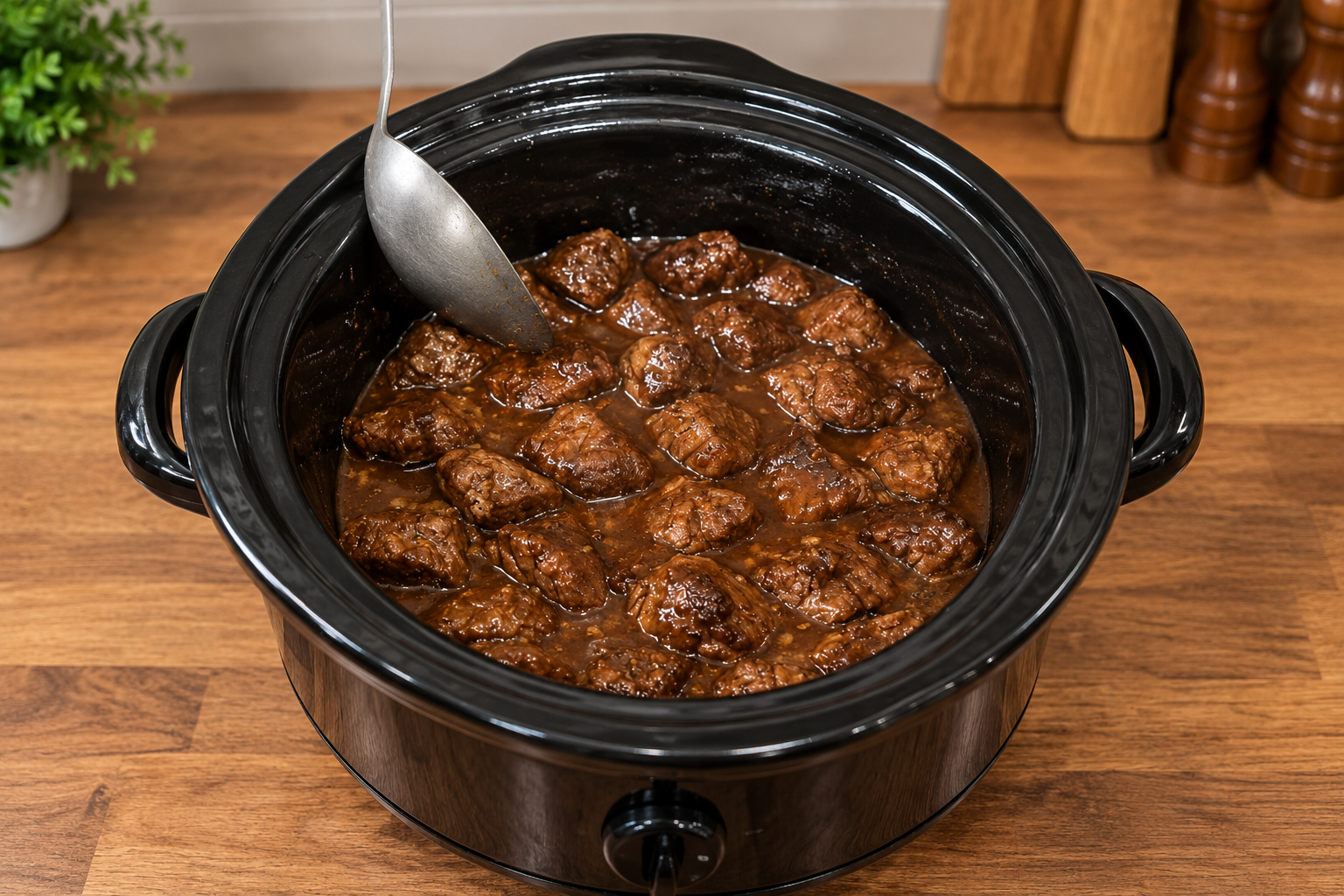
The photo above is the hard-earned victory sitting on my wooden kitchen counter: a deep black oval slow cooker packed with succulent, fork-tender beef bites coated in an ultra-luxurious, dark mahogany garlic-butter gravy, with a silver ladle scooping through the velvety sauce.
Here is how you make foolproof, melt-in-your-mouth Slow-Cooker Garlic Butter Steak Bites at home without ending up with tough, boiled meat or a thin, watery sauce.
Why Slow-Cooker Steak Bites Go Wrong (The Meat & Heat Physics)
Cooking bite-sized beef in a slow cooker is a test of moisture management and meat anatomy. If your beef tips have ever turned out chewy, dry, or grey, here is what happened behind the scenes:
1. The Lean Meat / “Stew Meat” Trap
Never grab random packages labeled “Beef Stew Meat” or use lean cuts like top round, eye of round, or sirloin tip for a multi-hour slow cooker braise. Lean cuts have almost no intramuscular fat or collagen; simmering them in liquid for hours simply squeezes out every drop of moisture, leaving the muscle fibers dry and stringy. The undisputed king of slow-cooker steak bites is boneless beef chuck roast (or well-marbled beef short rib meat). Chuck roast is packed with connective tissue that melts into rich gelatin between 195°F and 205°F, basting the beef cubes from within until they can literally be cut with a spoon.
2. Skipping the Hard Maillard Sear
A slow cooker simply cannot brown meat. The temperature inside the crock stays around 200°F in high humidity, which will only steam or boil raw meat, leaving it with an unappetizing pale grey exterior. Searing the beef cubes in a smoking-hot skillet for 90 seconds per side beforehand triggers the Maillard reaction. This caramelizes the surface sugars and proteins into a dark, savory mahogany crust that locks in juices and enriches the entire sauce.
3. Adding Too Much Liquid to the Crock
A slow cooker is a completely enclosed steam chamber. As beef cooks, it naturally releases roughly 20% to 25% of its internal moisture. If you pour two cups of broth into the crock at the start, you are boiling the steak bites in water. You only need a small splash of liquid to deglaze the searing skillet; the beef, melting butter, and aromatics will create plenty of rich, concentrated cooking juices on their own.
Ingredients & Tools You’ll Need
Essential Kitchen Gear
- 6-Quart Oval Slow Cooker: (A ceramic slow cooker, like the black unit in the photo, provides plenty of base area so the beef bites stay in an even layer rather than stacking too deep).
- 12-Inch Heavy Cast-Iron Skillet: Mandatory for getting a blistering-hot, dark caramelized crust on the beef cubes without steaming them.
- Large Metal Tongs: For flipping individual beef bites quickly during the hard sear.
- Flat Wooden Spatula: Essential for scraping the flavorful fond from the bottom of your skillet during deglazing.
- Sauce Ladle: (Like the stainless-steel ladle shown in the photo, for spooning the velvety mahogany gravy over bowls).
The Ingredient Breakdown
| Component | Ingredient | Quantity | Practical Role |
| The Star Beef | Boneless Beef Chuck Roast (well-marbled) | 2.5 to 3 lbs (cut into 1.5-inch cubes) | Rich in collagen that melts into tender, succulent gelatin. |
| The Searing Fat | High-Smoke-Point Oil | 2 tbsp (avocado or canola oil) | Allows blistering-hot browning without scorching or smoking. |
| The Garlic Butter | Unsalted Butter | 6 tbsp (divided: 2 tbsp for searing, 4 tbsp cubed for crock) | Coats the beef in rich dairy fat, creating that signature steakhouse shine. |
| Aromatic Core | Fresh Garlic Cloves | 6 to 8 cloves (finely minced) | Infuses the pan gravy with robust, sweet, aromatic garlic flavor. |
| Aromatic Core | Sweet Yellow Onion | ½ medium (finely minced) | Melts completely into the sauce, providing natural sweetness and body. |
| The Deglazer | Low-Sodium Beef Bone Broth (or Dry Red Wine) | ¾ cup | Lifts the caramelized beef fond from the skillet into the gravy. |
| Umami Engine | Worcestershire Sauce | 2 tbsp | Fermented savory backbone that deepens the beefy steakhouse flavor. |
| Richness Booster | Better Than Bouillon Roasted Beef Base | 1 tbsp | The secret weapon for deep color and concentrated steakhouse flavor. |
| Tomato Anchor | Tomato Paste | 1.5 tbsp | Blooms in butter to add color, depth, and mild acidity to balance rich fat. |
| Herbal Lift | Dried Thyme & Rosemary | 1 tsp dried thyme, ½ tsp crushed rosemary | Woodsy, aromatic herbs that perfume the slow-cooked gravy. |
| Dry Beef Rub | Garlic Powder, Onion Powder, Smoked Paprika | 1 tsp garlic powder, 1 tsp onion powder, ½ tsp paprika | Seasoning blend that forms a savory crust during the sear. |
| Base Seasoning | Coarse Kosher Salt & Cracked Black Pepper | 1.5 tsp salt, 1 tsp coarse black pepper | Crucial seasoning across the beef cubes and pan gravy. |
| The Gravy Glaze | Cornstarch Slurry | 1.5 tbsp cornstarch + 2 tbsp cold water | Thickens the braising liquid into that ultra-glossy, spoon-coating sauce. |
| Garnish | Fresh Parsley or Chives | 2 tbsp (finely chopped, optional) | Adds a bright pop of fresh green contrast right before serving. |
Step-by-Step Cooking Instructions
Step 1: Prep and Season the Beef Chuck
Take your beef chuck roast out of the refrigerator 20 to 30 minutes before cooking to take the deep chill off. Cold meat drops the skillet temperature instantly, causing beef to steam rather than brown.
Trim away any tough, rubbery white gristle or excess hard fat caps, but leave the fine webs of intramuscular fat intact.
Cut the beef into uniform, bite-sized 1.5-inch cubes.
Cook’s Real-Life Tip: Don’t cut the pieces too small! Beef naturally contracts and renders out moisture as it cooks. Starting with generous 1.5-inch cubes ensures your finished steak bites remain plump, hearty morsels rather than shriveled pellets.
Pat the beef cubes completely bone-dry on all sides with paper towels.
In a small bowl, combine the garlic powder, onion powder, smoked paprika, 1.5 teaspoons of coarse kosher salt, and 1 teaspoon of freshly cracked black pepper.
Toss the beef cubes in the seasoning blend until every piece is evenly coated.
Step 2: The Blistering Skillet Sear
Set your 12-inch heavy cast-iron skillet over high heat on the stovetop.
Add 1 tablespoon of high-smoke-point oil.
When you see a light wisp of smoke rising from the pan, add half of the seasoned beef cubes into the skillet in a single, spaced-out layer.
Do not crowd the skillet! If the cubes are touching, steam gets trapped between them, boiling the meat instead of searing it.
Sear untouched for 60 to 90 seconds on the first side until a deep, dark mahogany crust forms.
Quickly turn the pieces with tongs and sear the other side for another 60 seconds.
Transfer the seared beef cubes directly into your slow cooker insert.
Add another tablespoon of oil to the skillet and repeat the process with the remaining beef cubes, transferring them to the slow cooker once crusted.
The interior of the meat should still be raw at this stage—we are only searing to build flavor and color.
Step 3: Sauté the Aromatics and Deglaze the Pan
Turn the skillet heat down to medium-low.
Add 2 tablespoons of unsalted butter directly into the savory beef drippings remaining in the pan.
Add the finely minced yellow onion and minced fresh garlic.
Sauté gently for 2 minutes, stirring constantly with a flat wooden spatula until the onions soften and turn fragrant.
Stir in the 1.5 tablespoons of tomato paste and the dried thyme and rosemary. Cook the paste against the hot pan for 60 seconds to bloom the spices and cook out the raw tinny flavor.
Pour in the ¾ cup of beef bone broth (or dry red wine), 2 tablespoons of Worcestershire sauce, and 1 tablespoon of Better Than Bouillon beef base.
The liquid will bubble vigorously.
Use your flat wooden spatula to scrape firmly across the bottom of the skillet, loosening all the caramelized, browned beef bits (fond) stuck to the metal.
Let the liquid simmer for 2 minutes until the bouillon dissolves completely and the mixture forms a dark, fragrant sauce base.
Remove the skillet from the heat.
Step 4: Layer and Load the Slow Cooker
Pour the warm, seasoned skillet sauce directly over the seared beef cubes in the slow cooker.
Cut the remaining 4 tablespoons of cold butter into small pats.
Scatter the butter pats evenly across the top of the beef bites.
As the slow cooker warms up, the butter will slowly melt down over the meat, basting each cube in rich dairy fat and keeping the edges tender throughout the braise.
Visual Check: Notice that the liquid does not submerge the beef. It should sit around the lower half of the meat cubes. As the chuck cooks, it will release its own juices, creating plenty of rich cooking liquid.
Step 5: The Low-and-Slow Braise
Clamp the lid onto the slow cooker.
- Low Setting (Strongly Recommended): Cook for 5 to 6 hours.
- High Setting: Cook for 3 to 3.5 hours.
The Golden Rule: Keep the lid closed! For the first four hours, do not lift the lid to check or stir. Every time the lid is removed, trapped steam escapes and the internal temperature drops drastically, adding 20 minutes to your cook time.
Around the 5-hour mark on Low, test a beef cube with a fork: it should yield effortlessly with zero resistance, tender enough to break apart with gentle pressure while still holding its clean, bite-sized shape.
Step 6: Thicken into that Glossy Steakhouse Gravy
Turn your slow cooker setting to HIGH.
In a small cup or ramekin, whisk together 1.5 tablespoons of cornstarch with 2 tablespoons of cold water until you have a smooth, milky slurry with zero lumps.
Gently pour the cornstarch slurry into the bubbling liquid in the slow cooker, stirring carefully with a wooden spoon so you don’t break up the tender beef cubes.
Leave the slow cooker uncovered on High for 10 to 15 minutes, stirring occasionally.
As the cornstarch activates in the hot liquid, the thin cooking juices will transform into an ultra-rich, glossy, dark mahogany garlic-butter gravy that coats the back of a spoon like velvet (exactly as pictured in the reference photo).
Turn the slow cooker to “WARM”.
Step 7: Rest and Serve
Let the slow cooker rest on the Warm setting for 5 minutes before serving.
This brief pause lets the gravy stabilize and allows the tender beef fibers to soak up the rich, buttery sauce.
Using a metal sauce ladle, stir gently to coat every morsel of beef in the glistening gravy.
Scatter finely chopped fresh parsley or chives across the top for a bright, vibrant herbal contrast.
Serve hot straight from the slow cooker!
Practical Troubleshooting & Common Mistakes
- “My steak bites turned out tough and chewy.”
If you used beef chuck roast and it feels tough, it simply hasn’t cooked long enough! Beef chuck contains dense collagen that only breaks down after hours of sustained heat. If it is chewy at hour 4, clamp the lid back on and let it cook for another hour on Low until the connective tissue surrenders into gelatin. - “The sauce is greasy and separated.”
Chuck roast naturally renders fat as it cooks, and combining that with butter can sometimes create a visible oil slick. If excess oil floats to the top, use a wide metal spoon to gently skim the clear fat off the surface before stirring in the cornstarch slurry. The slurry will also help bind the remaining butterfat into a smooth, cohesive glaze. - “The meat lacks a rich, deep flavor.”
This happens if you skip the hard skillet sear or forget to deglaze the pan fond. That browned crust on the meat and the caramelized drippings on the bottom of the skillet contain the vast majority of the flavor. Always take the extra five minutes to sear the beef in cast iron before slow cooking.
Delicious Upgrades & Variations
While this classic garlic butter and herb combination is unbeatable comfort food, you can easily adapt the recipe to suit your cravings:
- The Sautéed Mushroom & Onion Boost: Sauté 8 ounces of sliced cremini mushrooms and a sliced yellow onion in butter until golden brown, and add them to the slow cooker alongside the beef for a rich, earthy steakhouse twist.
- The Spicy Cajun Kick: Swap the dried herbs for Cajun or Blackened seasoning, add a splash of hot sauce to the braising liquid, and finish with sliced scallions for a bold, zesty punch.
- The Creamy Stroganoff Twist: During the final ten minutes on High, stir in ½ cup of sour cream or cream cheese alongside the cornstarch slurry for a rich, velvety beef stroganoff gravy.
What to Serve with Garlic Butter Steak Bites
These tender, saucy beef bites are exceptionally rich and flavorful, making them the ultimate centerpiece for comforting, carb-heavy sides that can soak up every drop of that mahogany gravy:
- Buttery Garlic Mashed Potatoes: The gold standard. Spooning these fork-tender steak bites and generous ladles of glossy garlic-butter gravy directly over a fluffy mound of Yukon Gold mashed potatoes is pure comfort food heaven.
- Buttered Wide Egg Noodles: Toss cooked egg noodles with butter, fresh parsley, and cracked black pepper; the rich gravy clings to the ribbons effortlessly.
- Warm Crusty French Bread or Sourdough: Mandatory for wiping the bowl completely clean of every drop of garlic-herb butter sauce.
- Roasted Green Beans or Steamed Asparagus: A crisp, vibrant green vegetable tossed with a squeeze of fresh lemon juice provides a sharp, refreshing contrast that cuts right through the rich beef and butter.
Storing and Reheating Leftovers
If you have leftover steak bites, transfer the beef and gravy into an airtight glass container and store in the refrigerator for up to 4 days.
Because chuck roast is rich in natural gelatin, the gravy will set into a thick, solid jelly once chilled. This is completely normal and a sign of great culinary texture!
When reheating, avoid blasting the beef in the microwave on high power, which can cause the butterfat to separate into grease and turn the tender beef rubbery.
Instead, use the gentle stovetop skillet method:
- Place your leftover steak bites and gravy into a skillet over medium-low heat.
- Splash in 2 to 3 tablespoons of beef broth or water to loosen the chilled gravy.
- Cover the skillet and heat gently for 5 to 6 minutes, stirring occasionally, until the beef is piping hot and the gravy melts back into a silky, glossy sauce.
Serve over fresh rice, potatoes, or tuck them into warm hoagie rolls with melted provolone cheese for the best steakhouse lunch you’ll ever have!