
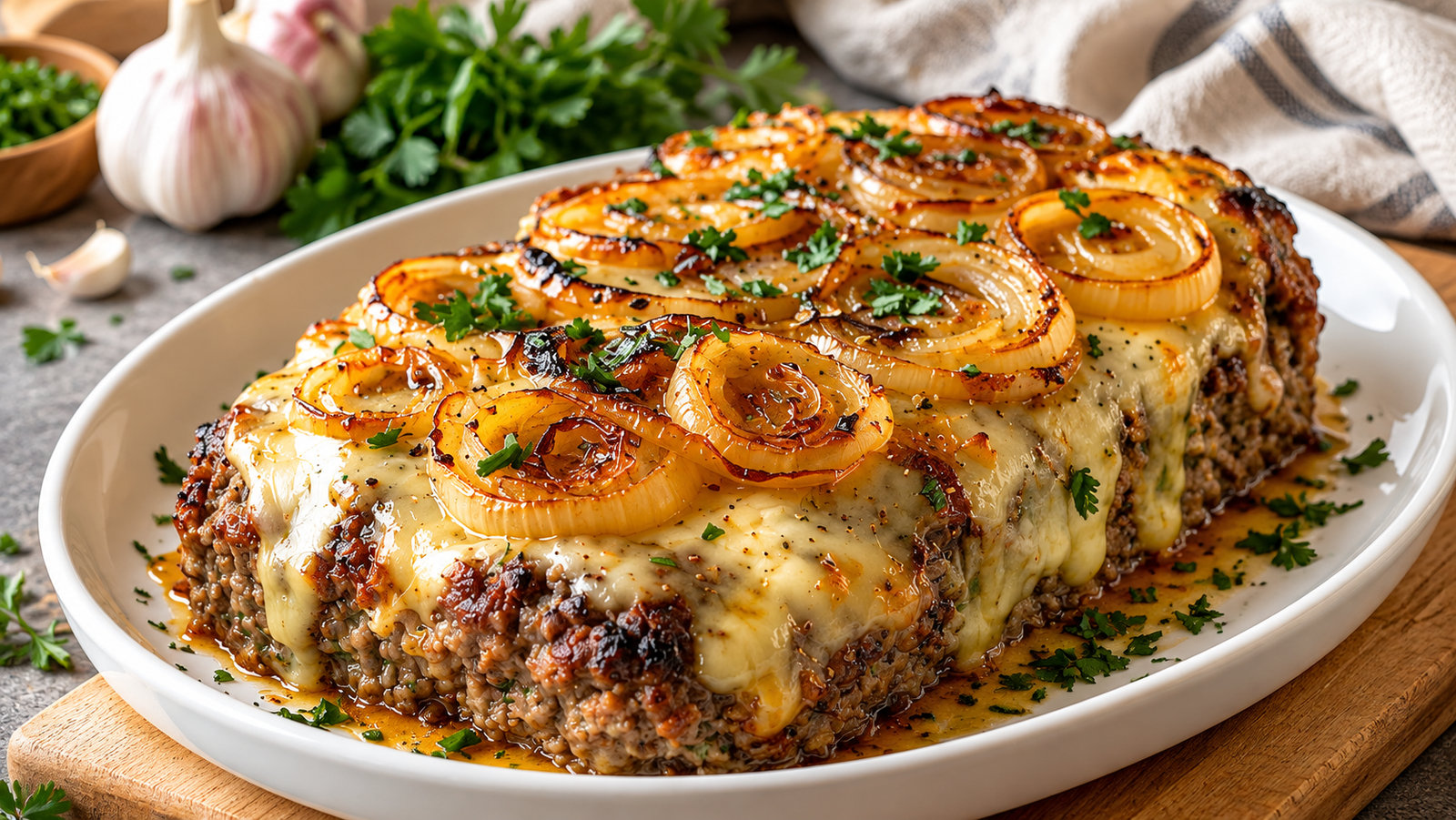
A few months back, I was standing in front of my open refrigerator at 6:00 PM, staring blankly at two packages of ground beef. I had zero desire to make regular meatloaf with the usual sugary ketchup topping, and our household had eaten tacos twice the week before.
What I really wanted was a steaming bowl of French onion soup from our neighborhood bistro—that deeply savory, rich beef broth packed with sweet, jammy caramelized onions and blanketed in bubbly, melted Gruyère.
That was when the lightbulb flickered on: why not combine the two? What if I made an all-beef meatloaf seasoned with rich beef base, Worcestershire, and fresh thyme, and topped the entire thing with melted Swiss and Gruyère cheese, nestled under a crown of golden caramelized onion rings?
My first attempt had great flavor, but visually and structurally, it was a mess. I rushed the onions, burned them at high heat, and piled them directly onto the raw meat before baking. The raw moisture trapped underneath steamed the beef, the cheese slid completely off the loaf into a puddle of grease, and the onions charred into bitter black threads.
I went back to the drawing board, refined the sequence, and nailed the balance. The result is what you see in that photo: an intensely juicy, fork-tender beef loaf topped with a thick layer of melted, bubbly cheese, smothered in slow-cooked, golden caramelized onions, and basted in rich savory pan juices. It has completely dethroned every other meatloaf recipe in my house.
Here is exactly how to pull it off, step by step, without the headaches I went through.
The Secret to Nailing French Onion Flavor in a Loaf
Capturing that Parisian bistro flavor profile takes more than just tossing a packet of onion soup mix into ground meat. Here are the core pillars that make this work:
1. Low and Slow Caramelization
You cannot rush the onions. If you crank the heat to high, onions brown on the edges before their natural sugars break down, leaving them pungent and acrid rather than sweet and melt-in-your-mouth tender. Giving thick onion slices twenty-five minutes in butter over medium-low heat transforms them into sweet, golden rings that hold their shape on top of the loaf.
2. The Breadcrumb Panade
Lean ground beef tightens up like a fist as its proteins cook, squeezing out juices. A traditional panade—soaking breadcrumbs in a liquid before mixing—creates tiny protective cushions throughout the meat matrix. Instead of milk, I use rich beef bone broth to soak the panko, infusing savory French onion soup flavor straight into the interior of the loaf.
3. The Two-Stage Broiler Finish
If you put cheese and already-caramelized onions on raw beef at the start of baking, the cheese burns and the onions dry out. Bake the seasoned loaf on its own first until it reaches safe internal doneness. Only then do you lay down the cheese and golden onion rings, popping the dish under the broiler for just a couple of minutes until the cheese is bubbling, gooey, and golden.
Ingredients & Kitchen Tools
Essential Gear
- Rimmed Baking Sheet or Oval Ceramic Roasting Dish: (An oval baking dish or rimmed sheet lined with foil lets hot air crisp all edges while catching flavorful pan juices).
- 12-Inch Cast-Iron or Stainless-Steel Skillet: For giving the onions ample space to brown evenly without crowding.
- Instant-Read Digital Thermometer: (A ThermoWorks ThermoPop or similar digital probe takes all the guesswork out of beef doneness).
- Flat Spatula: For transferring the loaf cleanly to a serving platter.
The Ingredients Breakdown
| Component | Ingredient | Measurement | Why It’s In The Recipe |
| The Meat | 80/20 Ground Chuck | 2 lbs (900g) | Fat provides crucial moisture and rich beefy flavor. |
| The Panade | Plain Panko Breadcrumbs | ¾ cup | Keeps the meat airy and tender without feeling heavy. |
| The Panade | Rich Beef Broth (or Bone Broth) | ½ cup | Hydrates the breadcrumbs with savory depth instead of plain milk. |
| The Binders | Large Eggs | 2 whole | Lightly beaten to hold the loaf together. |
| Savory Boosters | Better Than Bouillon Beef Base | 1 tbsp | The secret weapon for deep, bistro-style onion soup flavor. |
| Savory Boosters | Worcestershire Sauce | 2 tbsp | Essential fermented umami and savory tang. |
| Savory Boosters | Fresh Garlic | 3 cloves (minced) | Classic aromatic backbone. |
| Herbs & Spice | Fresh Thyme Leaves | 1 tbsp (chopped) | The signature herb of French onion soup. |
| Herbs & Spice | Kosher Salt | 1 tsp | Adjust slightly if your beef broth is already heavily salted. |
| Herbs & Spice | Coarse Black Pepper | 1 tsp | Freshly cracked peppery bite. |
| Onion Crown | Yellow or Sweet Vidalia Onions | 2 large | Sliced into ½-inch thick rounds. |
| Onion Crown | Unsalted Butter | 2 tbsp | For browning and sweetening the onion slices. |
| Onion Crown | Splash of Dry White Wine or Sherry | 2 tbsp | (Optional) To deglaze the pan and add authentic bistro acidity. |
| The Melty Top | Gruyère & Swiss Cheese | 1.5 cups (shredded or sliced) | Gruyère brings nutty depth; Swiss adds creamy, stretchy melt. |
| Garnish | Fresh Flat-Leaf Parsley | 2 tbsp (finely chopped) | Adds a pop of clean, bright green over the golden top. |
Step-by-Step Cooking Instructions
Step 1: Caramelize the Onion Rings
Peel your two large yellow onions. Carefully slice them into roughly ½-inch thick rounds, trying to keep the rings mostly intact rather than chopping them into strips.
Melt 2 tablespoons of butter in a large skillet over medium-low heat. Lay the onion slices in the pan in an even layer. Sprinkle with a small pinch of salt.
Cook slowly for about 20 to 25 minutes, flipping them gently every 5 to 7 minutes with a spatula. You want them soft, sweet, and golden-brown around the edges, but still holding their circular shape. If using white wine or dry sherry, splash it in during the last 2 minutes to deglaze all the browned bits from the pan. Remove from heat and set aside.
Step 2: Build the Beef Panade
In a large mixing bowl, combine the ¾ cup of panko breadcrumbs with the ½ cup of beef broth and 1 tablespoon of Better Than Bouillon beef base. Stir with a fork and let it sit on the counter for 5 to 7 minutes until the liquid is fully absorbed into a soft, savory paste.
Step 3: Whisk the Flavor Binders
Into that same bowl with the softened breadcrumbs, crack the 2 eggs. Add the Worcestershire sauce, minced garlic, chopped fresh thyme, kosher salt, and freshly cracked black pepper. Whisk everything together thoroughly with a fork until you have a uniform slurry.
Mixing all seasonings and aromatics directly into the wet binder beforehand means you won’t have to overwork the meat trying to distribute salt evenly later.
Step 4: Gently Form the Loaf
Add the 2 pounds of ground chuck into the bowl with the binder mixture.
Using your hands with fingers spread open like rakes, gently fold the meat into the seasoning paste just until no dry pockets of meat remain. Stop mixing the second it comes together. Compacting, kneading, or squeezing the meat will yield a rubbery, dense finished loaf.
Step 5: Shape and the First Bake
Preheat your oven to 375°F (190°C).
Lightly oil a rimmed ceramic baking dish or a foil-lined baking sheet. Turn the meat mixture out into the center and shape it into a neat, uniform loaf roughly 9 inches long, 5 inches wide, and about 2 inches high. Smooth the top so it provides a stable platform for the cheese later.
Slide the dish onto the center oven rack and bake uncovered for 40 to 45 minutes.
Step 6: Check the Internal Temperature
Using your instant-read digital thermometer, insert the probe into the center of the loaf. You want it reading around 155°F (68°C). (It will finish coming up to the safe 160°F mark under the broiler and during the resting period).
Carefully pull the baking dish out of the oven. If there is an excess pool of grease in the bottom of the dish, use a metal bulb baster or large spoon to gently ladle out a few tablespoons so the loaf doesn’t sit submerged in oil.
Step 7: Add the Cheese & Onion Crown
Switch your oven to the BROIL setting (on High if your oven has options).
Layer the shredded or sliced Gruyère and Swiss cheese generously across the entire top surface of the hot loaf, letting a little bit drape naturally down the sides.
Using tongs or a spatula, carefully arrange the warm, caramelized onion rings over the cheese in overlapping layers.
Drizzle a spoonful of the savory pan juices directly over the onions.
Step 8: The Golden Broiler Finish
Return the pan to the oven on the upper-middle rack, roughly 6 inches away from the broiler element.
Watch it like a hawk for 3 to 4 minutes.
You want the cheese fully melted, bubbling, and slightly toasted, with the caramelized onions glistening and hot. Remove the pan immediately once the edges turn golden.
Step 9: The Mandatory 10-Minute Rest
Do not cut into the meatloaf right now! Slicing it blazing hot will cause the cheese to slide off and all the savory interior juices to rush out onto the platter.
Let the loaf rest undisturbed in the warm baking dish for 10 minutes. This allows the meat fibers to relax and reabsorb moisture while the cheese sets slightly into a clean, sliceable blanket.
Scatter chopped fresh parsley over the top and spoon some of the rich, onion-scented pan drippings over each portion as you serve.
Pitfalls to Avoid
- Relying on Pre-Bagged Swiss Cheese: Pre-shredded bagged cheese is coated in starch and cellulose to prevent clumping on shelf displays. That coating keeps cheese from melting smoothly and often leaves a grainy film. Grate a block of real Gruyère or deli-counter Swiss yourself—it melts like silk.
- Baking inside a Deep Metal Bread Tin: A loaf pan traps rendered water and beef fat, basically boiling the bottom half of the meat. Free-form shaping on a flat baking dish or rimmed tray allows air to circulate around all four sides, creating a savory outer crust.
- Crowding Onions in a Small Pan: If you try to caramelize two large onions in an 8-inch skillet, they will pile on top of each other and steam instead of brown. Use your widest skillet (12-inch is ideal) so the rings touch the hot surface directly.
Leftover Upgrades
If you end up with leftover slices, wrap them securely and keep them in the fridge for up to 3 days.
Because of the rich onion and cheese profile, a cold leftover slice makes an incredible sandwich. Toast two thick slices of French sourdough, warm the meatloaf slice in a skillet until the cheese gets stretchy again, and slide it between the bread with a smear of Dijon mustard. It tastes like a French dip sandwich and a patty melt had a baby.