
The first time I tasted authentic Greek pastitsio at a seaside tavern in Nafplio, I thought it was pure culinary witchcraft.
A towering, razor-sharp cube of tubular pasta stood proudly on my plate, layered with rich, spiced meat sauce and topped with a bronzed, custardy blanket of béchamel that was as thick as mattress foam. It didn’t lean. It didn’t leak. It didn’t collapse into a sad heap of red grease.
Naturally, I returned home convinced I could recreate that magnificent architectural marvel on a casual Sunday.
It was a total disaster.
I boiled a standard box of ziti until soft, tossed it in a 9×13 glass casserole dish, poured hot meat sauce over it, whipped up a loose white sauce, and baked it immediately. The moment my spatula made contact, the entire casserole gave up the ghost.
The meat ran out like liquid mud, the pasta flattened into a slippery pile, and the béchamel slid completely off the top. When I tried to plate a slice, it looked like a bowl of chili mac that had fallen down a flight of stairs. My family ate it with soup spoons. It tasted fine, but visually and structurally, it was heartbreaking.
I spent the next two years obsessing over pastitsio mechanics—making batch after batch, testing Greek tubular pasta shapes, playing with egg binders, and learning how starch and gelatin behave under heat.
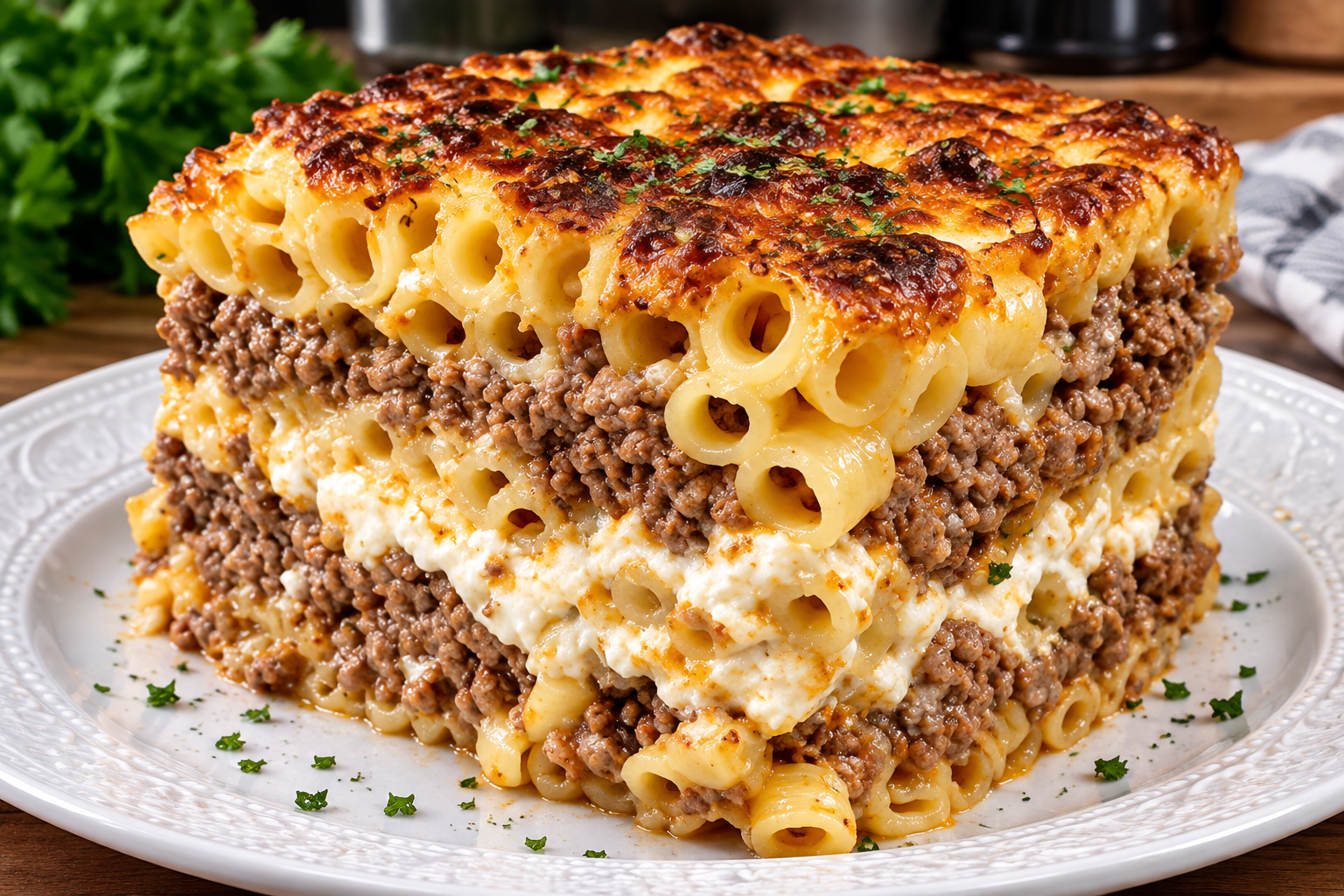
The image above is the ultimate victory: a sky-high, majestic slice showing distinct, vertical tubular pasta channels, rich spiced beef, velvety ricotta-feta pockets, and a caramelized, blistered cheese top that holds its razor-sharp edges without flinching.
Here is how you make this centerpiece dish without watching it turn into pasta stew on your dining table.
The Secret Structural Mechanics of Pastitsio
Pastitsio is often called “Greek lasagna,” but that nickname is deceptive. Lasagna uses flat, flexible sheets of pasta that drape over sauce. Pastitsio relies on rigid, tubular pasta that acts like structural rebar.
If your pastitsio collapses into a messy heap, it usually comes down to three fundamental kitchen mistakes:
1. The Missing Pasta Binder
In standard pasta bakes, sauce coats the noodles. In pastitsio, the noodles must adhere to one another like bricks in mortar. Greek grandmothers know the secret: once the pasta is boiled and drained, you toss it with lightly beaten egg whites and grated hard cheese. As the dish bakes in the oven, the egg whites cook and solidify, locking the hollow tubes together so they slice like cake without tumbling over.
2. A Runny, Watery Meat Sauce
A standard Italian Bolognese is often saucy, glossy, and loose. If you layer a loose sauce into pastitsio, the excess liquid floods the pasta layer, dissolving the binders. A pastitsio meat sauce must be cooked down low and slow until the liquid completely evaporates. The beef should look thick, concentrated, and jammy—coated in aromatics, tomato paste, and warm spices without a puddle of liquid fat floating on top.
3. The Custard-Style Béchamel (With Egg Yolks)
French béchamel is a loose sauce made of butter, flour, and milk. Pastitsio béchamel is technically a savory custard. Once the white sauce thickens on the stove and cools slightly, you whisk in egg yolks. In the oven, those yolks set firmly, creating that iconic thick, puffy, sliceable top crust with toasted brown freckles.
Ingredients & Equipment
Kitchen Tools That Matter
- Deep 9×13-inch Baking Pan (or High-Sided Springform/Casserole Pan): To get that glorious height, you need deep pan walls (at least 3 to 3.5 inches deep).
- Large 6-Quart Stockpot: Plenty of room to boil long tubular pasta without breaking the tubes.
- Heavy Dutch Oven or 12-inch Deep Skillet: For simmering and reducing the meat filling down into a thick, concentrated layer.
- Large Balloon Whisk: Indispensable for preventing lumps while cooking the thick béchamel.
- Sharp Chef’s Knife: For getting those clean, magazine-worthy vertical slices.
The Ingredient Breakdown
| Component | Ingredient | Quantity | Practical Role |
| The Pasta Base | Misko No. 2 (Greek Bucatini/Macaroni) or Bucatini Rigati | 1 lb (450g) | Long, thick tubular pasta that creates those hollow architectural cross-sections. |
| Pasta Binder | Large Egg Whites | 2 large | Tossed warm with the noodles to glue them together into a sliceable matrix. |
| Pasta Binder | Kefalotyri, Pecorino Romano, or Parmesan | ¾ cup (finely grated) | Adds salty, sharp bite while assisting the egg white binder. |
| Creamy Pocket | Whole-Milk Ricotta or Crumbled Greek Feta | 1 cup | Dolloped between pasta layers for a creamy, briny contrast. |
| The Meat Filling | 85/15 Ground Chuck (or 50/50 Beef & Lamb) | 2 lbs (900g) | Good fat content for flavor, cooked down until tender and rich. |
| Aromatic Foundation | Yellow Onion | 1 large (finely diced) | Softened to add sweetness and moisture to the meat. |
| Aromatic Foundation | Fresh Garlic | 4 cloves (minced) | Classic savory depth. |
| The Warm Spices | Ground Cinnamon | 1 tsp | The unmistakable, non-negotiable Greek tavern signature note. |
| The Warm Spices | Ground Cloves & Allspice | ¼ tsp each | Subtle, fragrant warmth that balances the tomato and beef. |
| Tomato Body | Tomato Paste & Crushed Canned Tomatoes | 2 tbsp paste, 1 can (14 oz) crushed | Delivers concentrated acidity and rich mahogany color without excess liquid. |
| Deglazing Splash | Dry Red Wine | ½ cup | Lifts browned bits from the pan and deepens the braised meat flavor. |
| Béchamel: Fat & Starch | Unsalted Butter & All-Purpose Flour | ½ cup butter (1 stick), ¾ cup flour | Equal-ratio blond roux to thicken the heavy milk volume. |
| Béchamel: Liquid | Whole Milk | 4.5 cups (warm) | Creates the velvety, luxurious white sauce. |
| Béchamel: Custard | Large Egg Yolks | 3 large (beaten) | Transforms the white sauce into a firm, sliceable custard layer. |
| Béchamel: Spice | Ground Nutmeg | ½ tsp (freshly grated) | Classic woodsy seasoning that brings white sauces to life. |
| Seasoning | Coarse Kosher Salt & Black Pepper | 2 tsp salt, 1.5 tsp pepper | Divided across all three distinct layers. |
Step-by-Step Cooking Instructions
Step 1: Cook Down the Concentrated Spiced Meat Sauce
Place your Dutch oven or large skillet over medium heat. Add a splash of olive oil and the diced yellow onion. Sweat the onions for 6 to 8 minutes until soft and translucent. Stir in the minced garlic and cook for 60 seconds until fragrant.
Crank the heat to medium-high and add the ground beef (and lamb, if using). Break the meat into small crumbles with a wooden spoon. Brown thoroughly for 8 to 10 minutes until no pink remains.
Pour off any heavy pools of grease that collect at the bottom of the pan, leaving about a tablespoon for rich mouthfeel.
Stir in the tomato paste, ground cinnamon, ground cloves, ground allspice, 1 teaspoon kosher salt, and freshly cracked black pepper. Cook for 2 minutes, letting the tomato paste toast against the hot metal.
Splash in the ½ cup of dry red wine to deglaze the skillet, scraping up every bit of browned fond stuck to the bottom. Add the 14-ounce can of crushed tomatoes.
Turn the burner down to medium-low. Let the meat simmer uncovered for 25 to 30 minutes.
Crucial Cook’s Step: Watch the pan closely during the final 10 minutes. You want almost all free liquid to evaporate. When you drag a wooden spoon across the center of the pan, it should leave a dry trail without a pool of red liquid rushing to fill the gap. Set the meat filling aside to cool slightly.
Step 2: Par-Boil the Tubular Pasta
Bring a large 6-quart stockpot filled with water to a rolling boil and add 2 tablespoons of kosher salt.
Drop in your Misko No. 2 tubular pasta (or bucatini).
Boil the pasta for 2 to 3 minutes less than the package instructions. The pasta must be distinctly al dente—it should bend easily, but the tube walls must feel firm. If you over-boil the noodles now, they will collapse under the weight of the meat and sauce in the oven.
Drain the pasta thoroughly in a colander. Shake aggressively to expel trapped water from inside the hollow tubes. Let it steam-dry for 3 minutes.
Step 3: Bind the Pasta Matrix
Transfer the warm, drained pasta into a large mixing bowl.
Drizzle with 2 tablespoons of melted butter and toss gently.
Lightly whisk your 2 egg whites in a small dish with a fork until frothy. Pour the egg whites over the warm pasta, immediately followed by ½ cup of grated Kefalotyri (or Pecorino Romano) cheese.
Toss thoroughly with tongs so every tube is coated in a glossy film of egg white and salty cheese. As the pasta bakes, this egg-and-cheese coating forms the invisible mortar that keeps the tubes standing tall when sliced.
Step 4: The Velvety Custard Béchamel
In a medium, heavy-bottomed saucepan, melt the ½ cup (1 stick) of unsalted butter over medium heat.
Whisk in the ¾ cup of all-purpose flour. Cook the roux for 2 minutes, whisking constantly, until it smells slightly nutty and bubbles gently (keep it pale; do not let it brown).
Gradually pour in the 4.5 cups of warm whole milk in a steady, slow stream while whisking vigorously with your balloon whisk. Whisking continuously prevents lumps from forming.
Bring the sauce to a gentle simmer over medium heat, whisking constantly along the bottom and corners of the pot. Once it begins to bubble, it will thicken into a rich, heavy sauce that coats the back of a spoon.
Remove the saucepan from the heat. Whisk in the freshly grated nutmeg, 1 teaspoon kosher salt, ½ teaspoon black pepper, and ¼ cup of grated cheese.
Let the sauce cool on your counter for 5 to 7 minutes.
Once the sauce is lukewarm, whisk in the 3 beaten egg yolks rapidly until the mixture is uniform and silky-smooth.
Cook’s Mistake to Avoid: Never dump egg yolks into boiling-hot béchamel straight off the burner! The intense heat will scramble the eggs instantly, leaving yellow flecks throughout your sauce. Let the white sauce cool slightly before tempering in the yolks.
Step 5: The Strategic Tower Assembly
Preheat your oven to 350°F (175°C). Generously grease the bottom and deep sides of your baking dish with butter or olive oil.
- The Foundation Layer: Take roughly two-thirds of the egg-white-coated tubular pasta and lay it in the bottom of the dish. (For that gorgeous vertical look in the photo, gently guide the long tubes so they lay parallel to each other across the base of the pan).
- The Creamy Pockets: Spoon small dollops of the whole-milk ricotta or crumbled Greek feta across the pasta.
- The Spiced Meat Blanket: Spoon half of the thick meat sauce over the pasta, pressing it down firmly with the back of a spoon so it nestles into the gaps between the noodles.
- The Second Pasta & Meat Layer: Arrange the remaining tubular pasta over the beef, followed by the rest of the spiced meat sauce, smoothing it out into an even, compact bed.
- The Custard Crown: Pour the rich, thickened béchamel across the top. Use an offset spatula to smooth it out from corner to corner in a thick, uniform layer.
- The Crust Garnish: Sprinkle the remaining ¼ cup of grated Kefalotyri or Pecorino cheese evenly across the top of the béchamel.
Step 6: Bake and Brown
Slide the uncovered baking dish onto the center rack of your preheated 350°F (175°C) oven.
Bake for 45 to 50 minutes.
The edges will bubble gently, and the béchamel will puff slightly like a soufflé.
To achieve that deep, caramelized tavern finish, switch the oven to BROIL (High) for the final 3 to 4 minutes.
Watch through the oven door: the top cheese will blister into deep golden-brown spots, and the custard will develop a firm, toasted skin. Pull the pan out the moment it matches the bronzed color in the photo.
Step 7: The Non-Negotiable Cooling Rule (The True Secret)
Do not touch this dish with a knife right now.
If you cut into pastitsio straight out of the oven, the piping-hot béchamel and warm meat sauce will collapse into a soupy puddle.
Set the dish on a wire rack or heatproof counter and let it rest undisturbed for at least 45 to 60 minutes.
As pastitsio cools from piping hot to pleasantly warm, the egg whites around the pasta solidify, the starch sets, and the egg yolks in the béchamel firm up into a silky, sliceable custard. The flavors will actually deepen and taste richer when warm rather than tongue-scalding hot.
Using a large, sharp chef’s knife, wipe the blade with a warm, damp paper towel between cuts. Slice down with firm, steady vertical cuts to produce crisp, clean square portions that reveal every single layer.
Practical Troubleshooting & Common Mistakes
- “My pasta layers slid apart when I sliced it.”
This happens when the pasta isn’t drained thoroughly, or if you skipped the egg white binder. Water trapped in hollow tubes dilutes the structure. Shake your colander aggressively, let the pasta steam-dry, and never skip tossing the noodles with egg whites and cheese before layering. - “The meat sauce turned greasy in the dish.”
Cheap high-fat ground beef releases substantial grease. Always drain off the excess rendered fat after browning the meat in Step 1. You want savory spiced tomato coating the meat, not free liquid grease floating around it. - “Can I use regular penne or ziti instead of long Greek macaroni?”
Yes, ziti or rigatoni works if you cannot find Greek Misko No. 2 pasta at an international market. However, long hollow pasta laid parallel to each other creates that stunning, honeycomb-like cross-section when sliced down the center.
Leftovers & The Next-Day Slice
Pastitsio is one of the rare baked pasta dishes that is actually better the next day.
Wrap the baking dish tightly and refrigerate for up to 4 days. When chilled, the pasta, beef, and custard solidify completely, making it possible to carve cold slices with mathematical precision.
To reheat, place a thick cold slice on a parchment-lined baking sheet and warm it in a 350°F (175°C) oven or toaster oven for 15 to 20 minutes. The béchamel will puff right back up, the bottom crust will re-crisp, and the center will turn warm, comforting, and fork-tender without losing its crisp geometric shape. Serve with a crisp Greek salad of cucumbers, kalamata olives, ripe tomatoes, and red wine vinaigrette to cut through the rich comfort of the bake.